ART – a living connection to ART History

The work of art must seize upon you, wrap you up in itself, carry you away. It is the means by which the artist conveys his passion; it is the current which he puts forth which sweeps you along in his passion.”  ― Pierre-Auguste Renoir 

This painting holds special significance to me

Madame Josse Bernheim-Jeune et son fils Henry [Mrs Josse Bernheim-Jeune and her son Henry]
Madame Josse Bernheim-Jeune et fils Henry [Mrs Josse Bernheim-Jeune and her son Henry]
I know a relative of the two people in this painting. About five months ago I had brunch in Oregon with a very interesting woman who is the daughter of the little boy (yes, it is a boy) who is sitting on his mother’s lap in this Renoir oil painting.  The woman I met (name withheld) is the friend of a friend I was travelling with. The woman in this painting would of course be her grandmother.  Her grandparents were friends with Renoir.  Her grandfather and his brother were established art dealers for the first generation of impressionists. So I looked up the painting which hangs in the Musée d’Orsay and thought I would share it with you.

About the painting:

Pierre Auguste Renoir (1841-1919) Mrs Josse Bernheim-Jeune and her son Henry – 1910 Oil on Canvas H. 92,5; W. 73,3 cm Paris, Musée d’Orsay

The model for this painting was Mathilde Adler (1882-1963). In 1901 she married her cousin, Josse Bernheim-Jeune (1870-1941) while her sister Suzanne (1883-1961) married his brother Gaston (1870-1953). For several years the Bernheim-Jeune brothers had been established as dealers for the first generation of Impressionists.
They had already turned to Renoir for a portrait of the two young fiancées, in September 1901. In 1910, he was approached once again. At his country property, Les Collettes, near Cagnes-sur-Mer, Renoir painted for Josse a portrait of his wife and their son Henry Dauberville (1907-1988).

THE BERNHEIM-JEUNE STORY

Extract of the article dedicated to Bernheim-Jeune in the Larousse Encyclopedia:

ʺBernheim-Jeune (said Bernheim), art dealer’s family native of Besançon which can be traced from the late XVIIIth century at the head of a business of painting supplies (frames and colours for the artists).

Succeeding Joseph Bernheim (1799 1859), his son Alexandre Bernheim (1839-1915) friend of Delacroix, Corot and Gustave Courbet, came to settle down in Paris in 1863, settled down at 8 rue Lafitte (on the advice of his fellow countryman of Besançon, G. Courbet). This is where Alexandre Bernheim presents the impressionists in 1874. Transferred in 1906 to 25 boulevard de la Madeleine and 15 rue Richepanse, the Bernheim gallery takes its real development under the supervision of Alexandre Bernheim’s sons, Josse Bernheim-Jeune (1870-1941) and Gaston Bernheim-Jeune (1870-1953). They organise (in particular) in 1901, the first Van Gogh exhibition, present Bonnard and Vuillard in 1906, Cézanne and Cross (1907), Seurat and Van Dongen (1908), Matisse (1910), Boundin, the ʺItalian Futuristsʺ (1912), Le douanier Rousseau (1916), R.Dufy and Vlaminck (1921), Modigliani (1922), Utrillo (1923), Marquet (1925), Gauguin (1930), having settled down avenue Matignon (1925)ʺ.

“Bernheim-Jeune indeed, is the first gallery to settle down avenue Matignon (at the corner of avenue Matignon and rue du Faubourg Saint-Honoré). Its new places were inaugurated by Gaston Doumergue, President of the French Republic, for the opening of the exhibition: ʺMasterpieces of the XIXth and XXth Centuryʺ.

“I have arrived more definitely than any other painter during his lifetime; honours shower upon me from every side; artists pay me compliments on my work; there are many people to whom my position must seem enviable…. But I don’t seem to have a single real friend!”Pierre-Auguste Renoir


Art Controversy – Barnett Newman’s “Voice of Fire”

Twenty four years ago a painting by Barnett Newman ignited a firestorm in Canada.

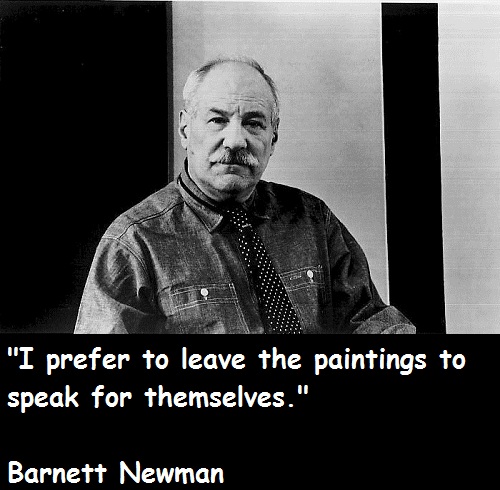
“In titles I try to evoke the emotional complex that I was under.” – Barnett Newman (1905-1970)

vof1

Which leads me to ask…what qualifies as art, especially in the increasingly bizarre world of modern art?

From Malevich’s Black Square, a pure black canvas, to DuChamp’s Fountain, a urinal turned upside down, modern art can take on forms from the bizarre to the mundane. This leaves many people wondering, how can these seemingly simple pieces become famous works of art?

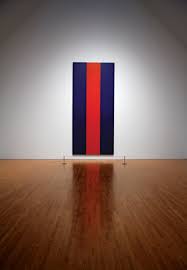
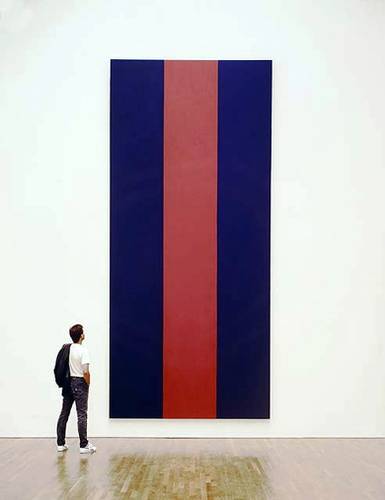
In 1990, The National Gallery of Canada made a controversial purchase of a well-known contemporary painting by Newman entitled “Voice of Fire” referred to as “the biggest art scandal in the country.” The painting is almost 18 feet tall and features a simple red stripe on a blue background.  Although Voice of Fire hung peacefully on loan in the gallery for two years, it was the subject of public outcry when, in the spring of 1990, the gallery decided to purchase the painting for $1.76 million.  More than two decades later, the almost $1.8-million price might sound modest, but it seemed extravagant then. vof2

As Capital News reported, the purchase was so highly contested by the public and the media that it was taken all the way to the House of Commons and sparked a fad of T-shirts and ties patterned after the painting.

If the fuss over the price seems quaint in hindsight, the deeper question is: Can three stripes, no matter how monumentally presented, be considered an important creation?—is not so easily dismissed.

The popular sentiment was that nearly 1.8 million of the tax payer’s dollars was a colossal waste of money for a painting widely dismissed as three stripes of colour. “My kid could have painted that” about sums it up (ignorantly if I may say so), with a fair sprinkling of “He’s not even Canadian!”

But supporters of the acquisition held that fine art shouldn’t have to be accessible; it’s there to challenge, and to push the boundaries. Newman’s work did that, especially when on display in the Gallery, where its enormous size and bold colours really were quite startling to behold. Plus, it was a work of some relevance to Canadians, even if Newman was an American painter: it had hung in the geodesic dome American Pavillion at Expo67 in Montreal.

vof2 (2)Limiting his colours to red and blue, he created this powerful vertical canvas to be suspended from the dome’s ceiling. While it appears simple in form, Voice of Fire conveys a range of meanings. Newman intended the work to be studied from a short distance; its enormous scale transforms the space and tests our sensory experience.

If the painting was sold today it would be worth in the area of $70 million.

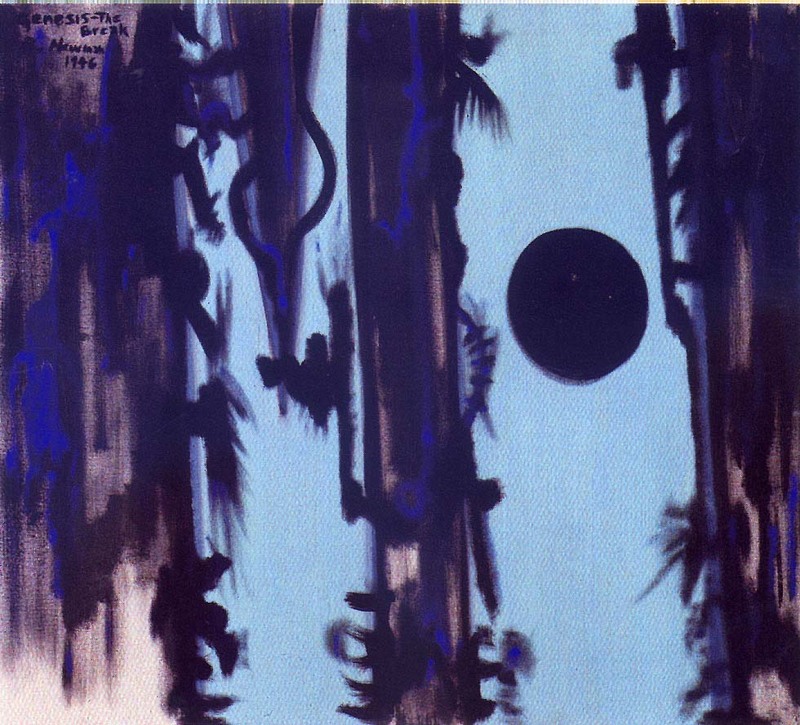
Genesis by Barnett Newman

Newman was born in New York City, the son of Jewish immigrants from Poland. He was known to be an articulate writer and spokesman for modern art. Newman was also very spiritual and saw his work as such. The Voices of Fire title comes from the biblical voice from the burning bush.

Taken from QueensJournal.ca & Maclean’s.ca

And as time will tell....it did!
As time always tells….it did!