Basel (pronounced the same way as the herb) is a charming city in Switzerland. Basel is so tucked away on the northern edge of the country, bordering both France and Germany, that it’s not on the regular Geneva-Bern-Lucerne-Zurich route and is often forgotten. And what a shame that is (I’ll tell you why in a minute).
But first A LITTLE HISTORY:
It’s worth a visit even to just ride the buses
Basel is Switzerland’s third most populous city (approx. 195,000 inhabitants) and is located where the Swiss, French and German borders meet with suburbs in France and Germany. Basel straddles Europe’s greatest river – the Rhine. A small part of the city (Kleinbasel) sits on the northern shore, even though the rest of that riverbank is German – and so acts as Switzerland’s gateway to the sea. It’s a very pretty little city too.
Basel on the Rhine
CULTURE: for many Swiss people, Basel means the three Fs: football, Fasnacht (a large popular festival) and pharmaceuticals, all loved and hated in equal measure. But Switzerland’s third largest city has a lot more to offer than some effing stereotypes, a fact that is also lost on many foreigners visiting Switzerland. ART is a BIG deal. So are museums.
Amid all the museums and galleries that crowd into Basel, perhaps the quirkiest is the one dedicated to the Swiss artist Jean Tinguely, aptly named “The Tinguely Museum.”
Jean Tinguely
Tinguely was born in Fribourg but grew up in Basel, and created the most amazing sculptures you are ever likely to see. Many look like they were put together by a mad scientist using laboratory leftovers. If you thought the Swiss were dull, this museum will change your mind. But I never thought they were dull. I had a Swiss German friend (a girl named Simone) who I met travelling in the Philippines who was extremely avantegarde and fun.
Moving right along, do you know what Basel, Miami Beach and Hong Kong have in common?
All three cities stage premier international art shows, providing a platform for artists and gallerists from all over the globe. It is considered the world’s largest and most prestigious fair for modern and contemporary art – goes by the name “ART BASEL.” Heard of it?
Art Basel was founded in 1970 by Basel art gallerists Ernst Beyeler, Trudi Bruckner and Balz Hilt. They put their passion and determination behind a visionary idea of their city anddecided to feature only museum quality art work. Art Basel was founded and met with an immediate approval, with more than 16,300 visitors its inaugural year. The fair used a selection process which chose the most elite and exclusive art galleries to participate. These special exhibitions allowed visitors to experience the art on a more global scale, as well as focus on particularly important featured artists.
After more than 30 years of shows, Art Basel extended its fair from Switzerland, to Miami in 2002. Just last year, Hong Kong was added to the list of art-forward cities to participate. Art Basel currently hosts 300 exhibitors from all over the world, with a reported 75,000 to Miami’s location, with many of the exhibitors entirely selling out.
The Art Market’s boom amid world economic sluggishness is a sign of the growing gulf between the rich and the super-super-rich. Taken from The Wall Street Journal (on Opinion Europe – June/20/2013):
A Matter of Taste and Millions
Samuel Lynne Galleries
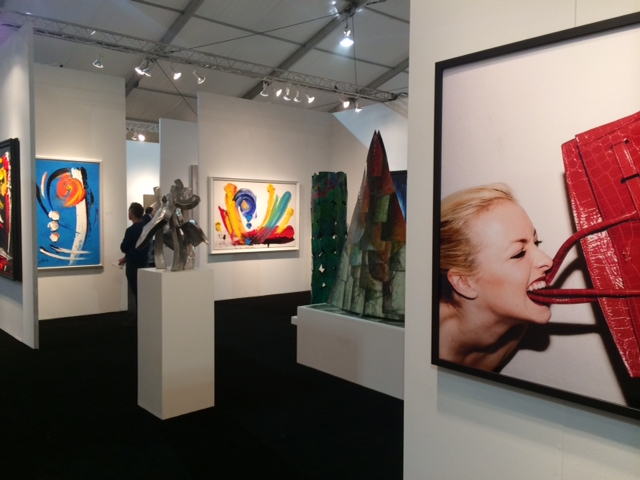
Art Basel is the world’s largest and most prestigious fair for modern and contemporary art. Art Basel offers collectors the most expansive and high quality buying venue of the year. It provides an extraordinary overview of primary and secondary market material. And, increasingly, it is responding to the growth of the global art market, offering a more comprehensive look at galleries and art making practices around the world. It has for a long time set the standard among art fairs.
Paul Cézanne (1839-1906) Born January 19 in Aix-en-Provence, France
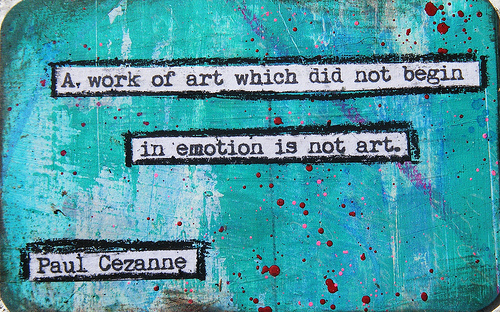
The most seductive thing about art is the personality of the artist himself – Paul Cézanne
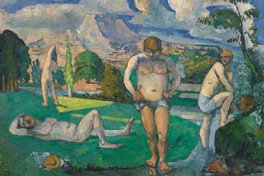
Bathers at Rest
Cézanne was best known for his incredibly varied painting style, which greatly influenced 20th century abstract art. Both Matisse and Picasso are said to have remarked that Cézanne “is the father of us all.” No small compliment.
In 1943, Pablo Picasso declared to photographer George Brassaï that artist Paul Cézanne was “my one and only master.”
The seminal moment for Picasso was the Cézanne retrospective held at the Salon d’Automne one year after the artist’s death in 1906. Though he previously had been familiar with Cézanne, it was not until the retrospective that Picasso experienced the full impact of his artistic achievement. As he later put it: “Cézanne’s influence gradually flooded everything.”
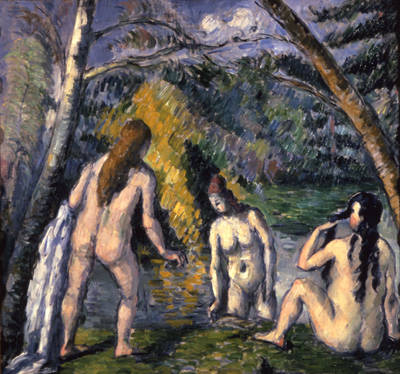
Three Bathers, 1879-82 Oil on canvas 21 7/16 x 20 5/16 in. (55 x 52 cm) Petit Palais, Musée des Beaux-Arts de la Ville de Paris
Cézanne early recognized the limitations of the Impressionists in their adherence to “honoring the eye” and reacted by constructing a new artistic vocabulary that synthesized reality and abstraction, the backbone of early Modernism. He also revitalized the classical concept of the nude. In 1899, Henri Matisse purchased Cézanne’s small painting called Three Bathers(1879-82) from Vollard; it remained with him for three decades as a teaching model.
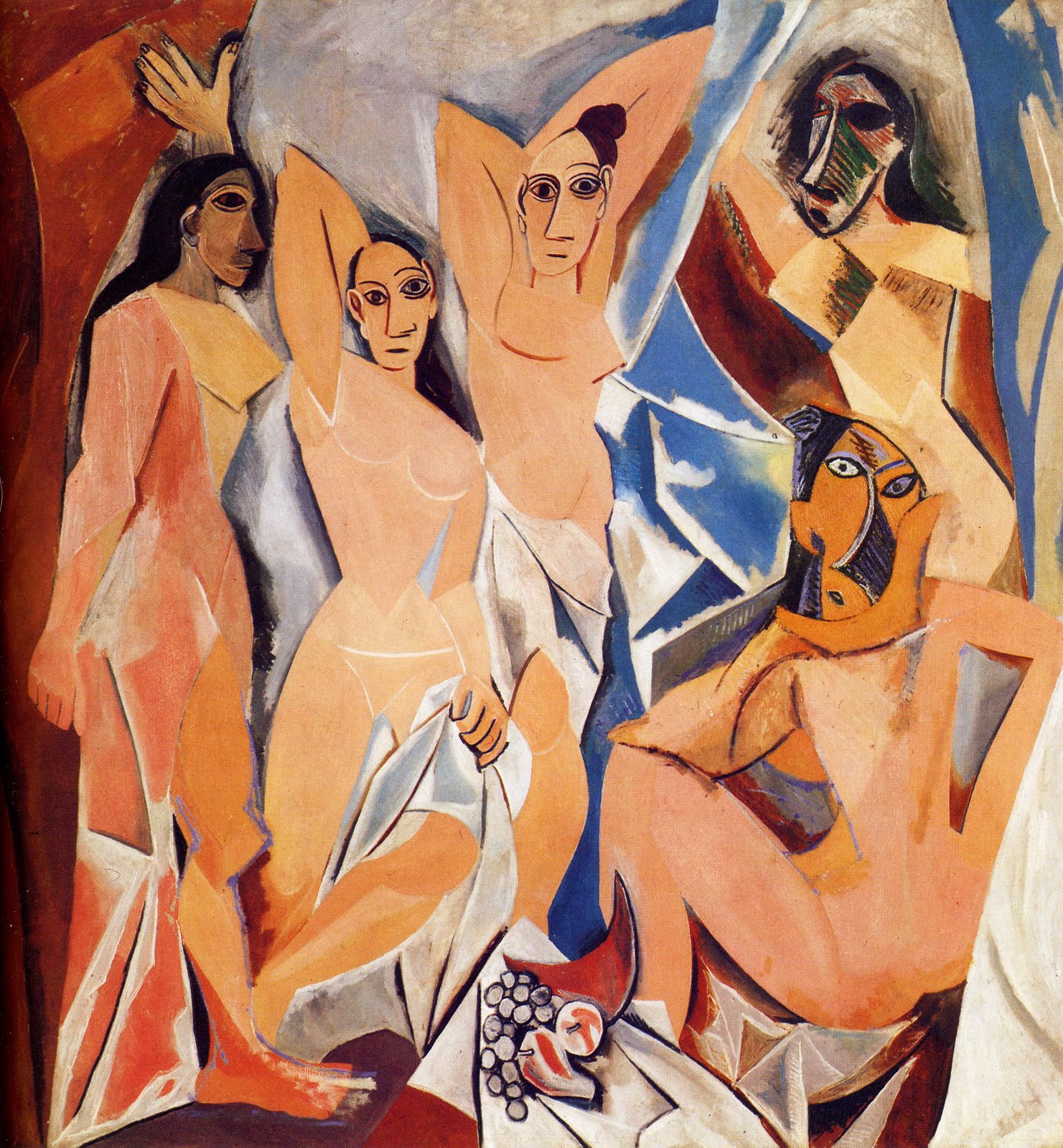
Pablo Picasso – Les Demoiselles d’Avignon
The work’s significance lies in its demotion of the nude to an earthbound status that would eventually reach the peak of its final metamorphosis in Pablo Picasso’s Les Demoiselles d’Avignon (1907). A comparative study of Picasso and Cézanne is not new. Imagine how many Ph.D. theses had been devoted to the topic.
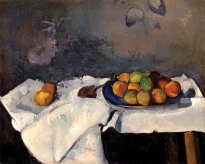
Still Life: Plate of Peaches, 1879-80. Oil on canvas, 59.7 x 73.3 cm. Solomon R. Guggenheim Museum, N.Y.
Cézanne set up his still lifes with great care. A testimony by an acquaintance describes his method of preparing a still life: “No sooner was the cloth draped on the table with innate taste than Cézanne set out the peaches in such a way as to make the complementary colors vibrate, grays next to reds, yellows to blues, leaning, tilting, balancing the fruit at the angles he wanted, sometimes pushing a onesous or two-sous piece [French coins] under them. You could see from the care he took how much it delighted his eye” (But when he began to paint, the picture might change in unusual ways. Cézanne seems to be painting from several different positions at once. He believed that the beauty of the whole painting was more important than anything else—even more important than the correctness of the rendering (Robert Burleigh, Paul Cézanne: A Painter’s Journey [New York: Harry N. Abrams, Inc., 2006], p. 18).
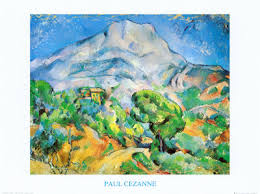
Inevitably, we see him as the point where modern art began: so the first room of theMuseum of Modern Art in New York, in its current hang, gives us a Gauguin and three Seurats on the left; outnumbering them, on the right and straight ahead, are half a dozen Cézannes. But, just as inevitably, in his own time they could see more clearly where he came from than where he would lead. So a friendly critic called him “a Greek of the Belle Époque”. Renoir said that his landscapes had the balance of Poussin, while the colours in his “Bathers” “seem to have been taken from ancient earthenware”. Cézanne, like all serious members of any artistic avant-garde, was constantly learning from previous masters, studying Rubens all his life. And while we might admire his daring fragmentations of vision, what the painter himself sought was “harmony”, which was nothing to do with “finish” or “style”.
Cézanne had his first one-man show in 1895, at the age of fifty-six.
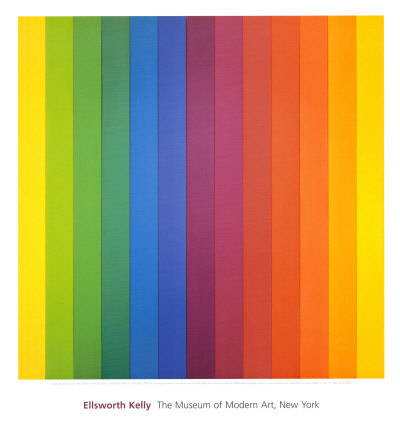
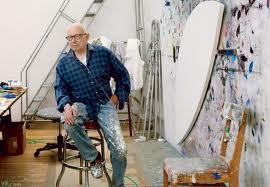
Ellsworth Kelly (American, born 1923) is a painter and sculptor who established his own style amidst the pervasive influence of the Abstract Expressionist and Pop Art movements.
“I have worked to free shape from its ground, and then to work the shape so that it has a definite relationship to the space around it; so that it has a clarity and a measure within itself of its parts (angles, curves, edges and mass); and so that, with color and tonality, the shape finds its own space and always demands its freedom and separateness.” – Ellsworth Kelly
MOMA
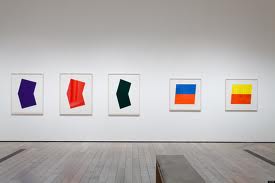
Maintaining a focus on the dynamic relationships between shape, form and color – Kelly was one of the first artists to create irregularly shaped canvases. His subsequent layered reliefs, flat sculptures, and line drawings further challenged viewers’ conceptions of space. While not adhering to any one artistic movement, Kelly virtually influenced the development of Minimalist, Hard-edge painting color field and Pop Art.
Kelly intends for viewers to experience his artwork with instinctive, physical responses to the work’s structure, color, and surrounding space rather than with contextual or interpretive analysis. He encourages a kind of silent encounter, or bodily participation by the viewer with the artwork, chiefly by presenting bold and contrasting colors free of gestural brushstrokes or recognizable imagery, panels protruding gracefully from the wall, and irregular forms inhabiting space as confidently as the viewer before them.
More Samplings
Background info:The Artist
Born in New York City, Kelly admired the works of Naturalist John James Audobon (American, 1785–1851) as a child and loved to draw, even though his parents only reluctantly permitted him to study at the Pratt Institute in Brooklyn, NY. After serving during World War II for two years as a camouflage artist, Kelly was able to study on the GI Bill at the School of the Museum of Fine Arts, in Boston, MA, and then at the École Nationale Supérieure des Beaux-Arts in Paris, France. Separated from the American art world while in Europe, Kelly developed his distinctive method of painting. These works echo Kelly’s desire to separate himself from the traditional roles of composition and the artist’s hand. Kelly only returned to the US when he believed that the enthusiasm for Abstract Expressionism had died down enough to allow his work to get some visibility. By the end of the 1950s, he was internationally recognized for his monochromatic canvases, which began to take the shape of non-rectangular forms such as ovals and curves. Kelly also began to create sculptures similar to his paintings, featuring simple two-dimensional forms. In 1970, the artist moved to upstate New York, where he shifted his focus to create large outdoor sculptures concerned more with color than form. Many of his public works are now on display around the world. Kelly now lives and works in Spencertown, NY.
Sources: Artnet.com + theartstory.org
From the Lawren Harris exhibit at the Vancouver Art Gallery 03/30/14
If there is a particular artist that you’d like to see featured on this blog please let us know.
No matter which big city I’ve lived in or visited, there’s always a neighbourhood “find” to be found somewhere amongst the madness.
These images are from a walk in Vancouver’s West End. I love finding tranquility in this richly diverse downtown neighbourhood with countless high rises and commercial businesses.
Vancouver is one of the most densely populated cities in North America after New York City and San Francisco. This is a direct result of urban planning focused on high-rise residential and mixed-use development as opposed to urban sprawl.
The West End epitomizes the city’s entire downtown core: It is family-oriented and gay-friendly, ultra-urban and tree-lined traditional, a beach town and a downtown combined. The best of “all” worlds.
The little coffee shop that’s not Starbucks.
For residents “the neighbourhood” becomes an extension of our personal identity and we’re so lucky to have them. Check out some of the local housing (below). Please don’t make them obsolete.
All good things must come to an end. Like the self indulging 80’s! Too bad if you weren’t around to experience it – there’s never been anything like it since. But maybe that’s a good thing. Thank goodness there was no instagram!
All photos by Fan Zhong – Take out your check because this culture is Expensive.
The nightclub known as “Area” was of its own time, but also way ahead of its time: there was a convergence of art, music, performance and fashion – where the only constant was change. That was then.
With three bars, a shark tank, and a swimming pool the downtown imaginarium known as “Area” welcomed all manner of wildlife, from Andy Warhol and Jean-Michel Basquiat to Madonna and Grace Jones to Marc Jacobs and Calvin Klein to the chameleonic Bernard Zette, a man who might arrive on any given night as a mermaid or, say, Anne Frank.
The bathroom was its own special club within the club, an orgy of anonymous sex and a wildly eclectic marketplace (condoms, chicken sandwiches, or Comme des Garcons jackets could all be had at cost), the whole scene powdered faintly in white. It was, after all, the ’80s.The nightclub-as-art-gallery that came to define the creative hedonism of 1980s New York, was resurrected for a single night last Tuesday at the Hole Gallery on the Bowery. The occasion was a new book, “Area” a 368-page homage (Abrams) to the over-the-top thematic parties that took place during the club’s storied 1983-to-1987 run.
The sidewalk was crammed with kooky artists and well-dressed celebutantes, craning their necks to get a glimpse of “Invisible Sculpture,” a piece by AndyWarhol that consists of a pedestal and a wall label. Inside, a sweaty mass of latter-day club kids and downtown royalty squeezed past a Barbara Kruger mural, brushed up against naked dancers and jostled for cocktails served in faux Campbell’s Soup cans.
The show was curated by Jeffrey Deitch and others, including the Area alums Eric Goode, Jennifer Goode and Serge Becker. It was also Mr. Deitch’s first exhibition after leaving the Museum of Contemporary Art, Los Angeles, and the party not only evoked the sybaritic spirit of the club, but also the fashionable scene cultivated by his gallery in the 1990s and early 2000s.
In addition to Warhol and Kruger, the show had rare works by Jean-Michel Basquiat, Francesco Clemente, Kenny Scharf, Keith Haring and others art stars of the 1980s — many created originally for Area. A row of nonworking toilets was also installed, prompting plenty of knowing chuckles and Instagram moments. (The exhibition ended November 10th).
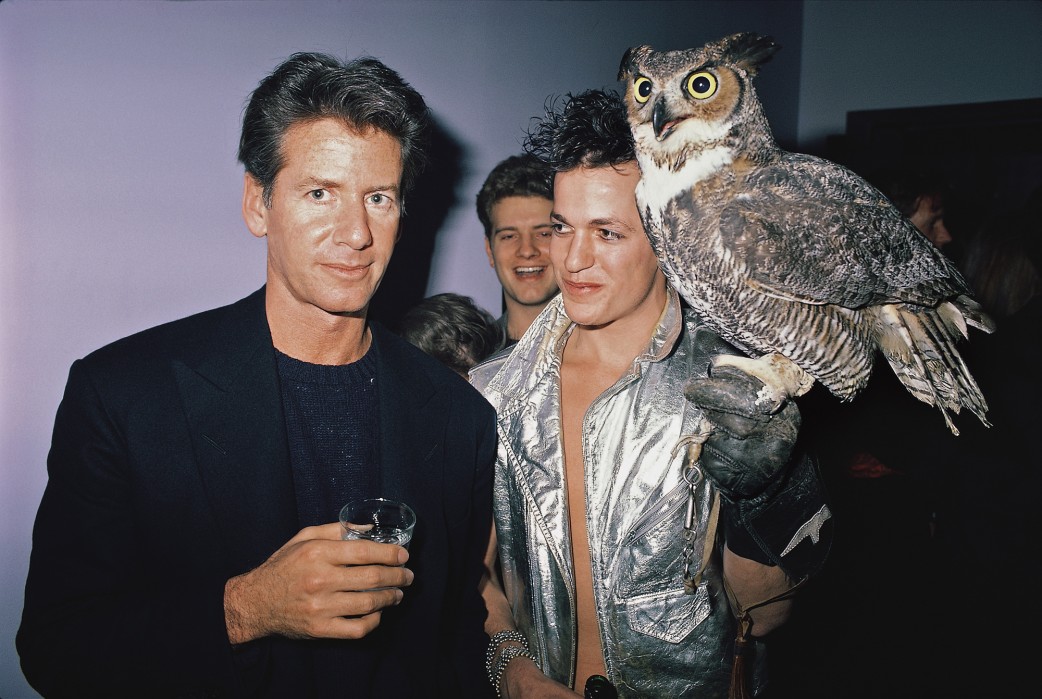
Calvin Klein and Tommy Street with an owl.
At one point Calvin Klein showed up, standing before a wall of Ronald Reagan posters created for a Hollywood party in 1984. “It was a different experience every time,” Mr. Klein said of the club, as he made his way for the exit. “You never knew what to expect. It was such a creative moment.” For some, the night brought back some of the debauched silliness of 1980s clubbing. Mirrored surfaces were dusted with fake piles of cocaine. Scantily clad performers simulated copulation. Drunken partygoers rolled around the floor.
Mr. Goode, who owns the Bowery and several other boutique hotels, surveyed the scene from a corner. “The late ’70s and early ’80s were a very special time in NewYork,” he said. “It was a think tank of artists. The city was very lawless.” He contrasted that to Mayor Michael R. Bloomberg’s gilded age, when community boards, night-life task forces and real estate prices have dampened the city’s creativity. Places like Area, he added, “would be impossible to pull off today.”
“We opened Area never expecting it to last,” writes Eric Goode in the preface to the new book Area: 1983 – 1987 ($75, abrams.com), an exquisite oral and pictorial history of the legendary—though short-lived—New York nightclub.
Over its four-year run, the warehouse space was made over anew approximately every six weeks: from its opening theme of “Night,” during which a masked welder lit up a dark dance floor with showers of sparks to a later incarnation called “Gnarly,” with a platoon of drag racers and nude bikers screeching across the 13,000 square foot space.
They don’t make em like they used to!
Taken in part from the New York TimesFashion & Style



 Moving right along, do you know what Basel, Miami Beach and Hong Kong have in common?
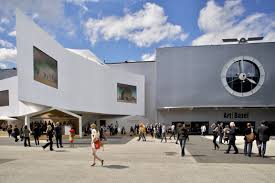 All three cities stage premier international art shows, providing a platform for artists and gallerists from all over the globe. It is considered the world’s largest and most prestigious fair for modern and contemporary art – goes by the name “ART BASEL.” Heard of it?











 Girl Who Would be KING on Life, Style and INSPIRATION.
You must be logged in to post a comment.