High up on my trippy wish list is Barcelona. Not only for fun but to pay a visit to the Fundació Joan Miró and be reminded that life is filled with colour and shape and that the small things in the world are worth noticing and celebrating.
Playful, joyful, energetic and colourful, Joan Miró’s paint language appears very simple – bird, star, sun, moon, figure, colour, surface, and so on. But like the best poets, the artist’s juggling of these elements is sophisticated and playful at the same time. The results are unique, immediately recognizable and vibrant – a delight to behold.
Miró was passionate about art from an early age and after a failed attempt by his family to get him into business, he was allowed to pursue his artistic studies. His early work was influenced by the Fauve painters and Cubism. He admired Picasso’s work and eventually left Barcelona to live in Paris where he spent six months of each year, working alongside other artists in relative poverty. The other half of the year he spent in Spain on the family farm.
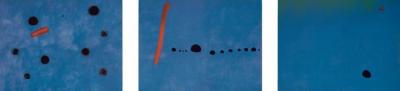
BLUE I, II AND III
Like his fellow Catalan artist, Salvador Dali, Miró is most closely associated with the surrealist movement started by Andre Breton. While Dali embraced surrealism wholeheartedly, with Miró it is more accurate to say that surrealism embraced him.
Constantly experimenting in his work, he was careful never to align himself completely with any one art movement. His take on the world is quirky, humorous, child-like in its depiction of subject-matter yet extremely sophisticated in its ability to comment on life’s experiences.
Dali, flamboyant, attention-seeking, extreme, takes us to the edge with paintings that show us a world that is distorted and disturbing. Miró’s approach is calmer, more playful. Always his own person, never interested in playing to the gallery, his work feels focused, centred, stable. His view of the world is uplifting, fun, life-enhancing.
Available at Elan Fine Art Limited,Vancouver
Above all, Miró reminds us how important a sense of humour is in life and his brilliant paintings, sculptures, wall hangings and ceramics give us permission to stop taking ourselves so seriously.
After Jackson Pollock, de Kooning was the most prominent and celebrated of the Abstract Expressionist painters.
Willem de Kooning (April 24, 1904 – March 19, 1997) was a Dutch American born in Rotterdam, Netherlands who was widely considered to be among the most important and prolific artists of the 20th century.
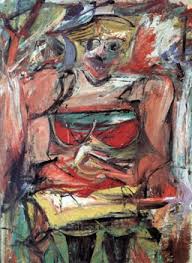
His pictures typify the vigorous gestural style of the movement and he, perhaps, did more than any other of his contemporaries to develop a radically abstract style of paining that used Cubism, Surrealism and Expressionism. Although he established his reputation with a series of entirely abstract pictures, he felt a strong pull towards traditional subjects and would eventually become most famous for his pictures of women, which he painted in spells throughout his life. Later he turned to landscapes, which were also highly acclaimed, and which he continued to paint even into his eighties, when his mind was significantly impaired by Alzheimer’s disease.
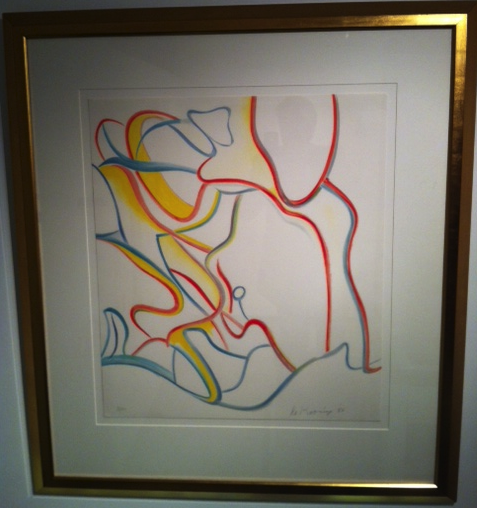
Gorgeous Abstract Composition Edition 98/100 Stone lithograph (1986 – 28 x 25 in.) Available at: Elan Fine Art Limited –Vancouver, B.C. info@elanfineart.ca
He possessed the polished techniques of painters in the New York School, one that compares to that of the Old Masters, and he looked to the likes of Ingres, Rubens and Rembrandt for inspiration. De Kooning’s influence on painters remains important even to this day, particularly those attracted to gestural styles; the highly abstract and erotic work of prominent 1990s painter Cecily Brown is inconceivable without his example.
“I’m not interested in ‘abstracting’ or taking things out or reducing painting to design, form, line, and color. I paint this way because I can keep putting more things in it � drama, anger, pain, love, a figure, a horse, my ideas about space. Through your eyes it again becomes an emotion or idea.” – de Kooning





 Girl Who Would be KING on Life, Style and INSPIRATION.
You must be logged in to post a comment.