ART – a living connection to ART History

The work of art must seize upon you, wrap you up in itself, carry you away. It is the means by which the artist conveys his passion; it is the current which he puts forth which sweeps you along in his passion.”  ― Pierre-Auguste Renoir 

This painting holds special significance to me

Madame Josse Bernheim-Jeune et son fils Henry [Mrs Josse Bernheim-Jeune and her son Henry]
Madame Josse Bernheim-Jeune et fils Henry [Mrs Josse Bernheim-Jeune and her son Henry]
I know a relative of the two people in this painting. About five months ago I had brunch in Oregon with a very interesting woman who is the daughter of the little boy (yes, it is a boy) who is sitting on his mother’s lap in this Renoir oil painting.  The woman I met (name withheld) is the friend of a friend I was travelling with. The woman in this painting would of course be her grandmother.  Her grandparents were friends with Renoir.  Her grandfather and his brother were established art dealers for the first generation of impressionists. So I looked up the painting which hangs in the Musée d’Orsay and thought I would share it with you.

About the painting:

Pierre Auguste Renoir (1841-1919) Mrs Josse Bernheim-Jeune and her son Henry – 1910 Oil on Canvas H. 92,5; W. 73,3 cm Paris, Musée d’Orsay

The model for this painting was Mathilde Adler (1882-1963). In 1901 she married her cousin, Josse Bernheim-Jeune (1870-1941) while her sister Suzanne (1883-1961) married his brother Gaston (1870-1953). For several years the Bernheim-Jeune brothers had been established as dealers for the first generation of Impressionists.
They had already turned to Renoir for a portrait of the two young fiancées, in September 1901. In 1910, he was approached once again. At his country property, Les Collettes, near Cagnes-sur-Mer, Renoir painted for Josse a portrait of his wife and their son Henry Dauberville (1907-1988).

THE BERNHEIM-JEUNE STORY

Extract of the article dedicated to Bernheim-Jeune in the Larousse Encyclopedia:

ʺBernheim-Jeune (said Bernheim), art dealer’s family native of Besançon which can be traced from the late XVIIIth century at the head of a business of painting supplies (frames and colours for the artists).

Succeeding Joseph Bernheim (1799 1859), his son Alexandre Bernheim (1839-1915) friend of Delacroix, Corot and Gustave Courbet, came to settle down in Paris in 1863, settled down at 8 rue Lafitte (on the advice of his fellow countryman of Besançon, G. Courbet). This is where Alexandre Bernheim presents the impressionists in 1874. Transferred in 1906 to 25 boulevard de la Madeleine and 15 rue Richepanse, the Bernheim gallery takes its real development under the supervision of Alexandre Bernheim’s sons, Josse Bernheim-Jeune (1870-1941) and Gaston Bernheim-Jeune (1870-1953). They organise (in particular) in 1901, the first Van Gogh exhibition, present Bonnard and Vuillard in 1906, Cézanne and Cross (1907), Seurat and Van Dongen (1908), Matisse (1910), Boundin, the ʺItalian Futuristsʺ (1912), Le douanier Rousseau (1916), R.Dufy and Vlaminck (1921), Modigliani (1922), Utrillo (1923), Marquet (1925), Gauguin (1930), having settled down avenue Matignon (1925)ʺ.

“Bernheim-Jeune indeed, is the first gallery to settle down avenue Matignon (at the corner of avenue Matignon and rue du Faubourg Saint-Honoré). Its new places were inaugurated by Gaston Doumergue, President of the French Republic, for the opening of the exhibition: ʺMasterpieces of the XIXth and XXth Centuryʺ.

“I have arrived more definitely than any other painter during his lifetime; honours shower upon me from every side; artists pay me compliments on my work; there are many people to whom my position must seem enviable…. But I don’t seem to have a single real friend!”Pierre-Auguste Renoir


ART/Culture/Cézanne 

Paul Cézanne (1839-1906) Born January 19 in Aix-en-Provence, France

The most seductive thing about art is the personality of the artist himself – Paul Cézanne

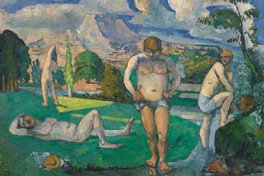
Bathers at Rest
              Bathers at Rest

Cézanne  was best known for his incredibly varied painting style, which greatly influenced 20th century abstract art.  Both Matisse and Picasso are said to have remarked that Cézanne “is the father of us all.” No small compliment.

In 1943, Pablo Picasso declared to photographer George Brassaï that artist Paul Cézanne was “my one and only master.

The seminal moment for Picasso was the Cézanne retrospective held at the Salon d’Automne one year after the artist’s death in 1906. Though he previously had been familiar with Cézanne, it was not until the retrospective that Picasso experienced the full impact of his artistic achievement. As he later put it: “Cézanne’s influence gradually flooded everything.”

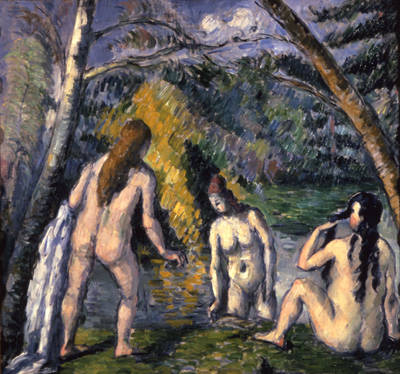
Three Bathers, 1879-82 Oil on canvas 21 7/16 x 20 5/16 in. (55 x 52 cm) Petit Palais, Musée des Beaux-Arts de la Ville de Paris
Three Bathers, 1879-82
Oil on canvas
21 7/16 x 20 5/16 in. (55 x 52 cm)
Petit Palais, Musée des Beaux-Arts de la Ville de Paris

Cézanne early recognized the limitations of the Impressionists in their adherence to “honoring the eye” and reacted by constructing a new artistic vocabulary that synthesized reality and abstraction, the backbone of early Modernism. He also revitalized the classical concept of the nude. In 1899, Henri Matisse purchased Cézanne’s small painting called Three Bathers (1879-82) from Vollard; it remained with him for three decades as a teaching model.

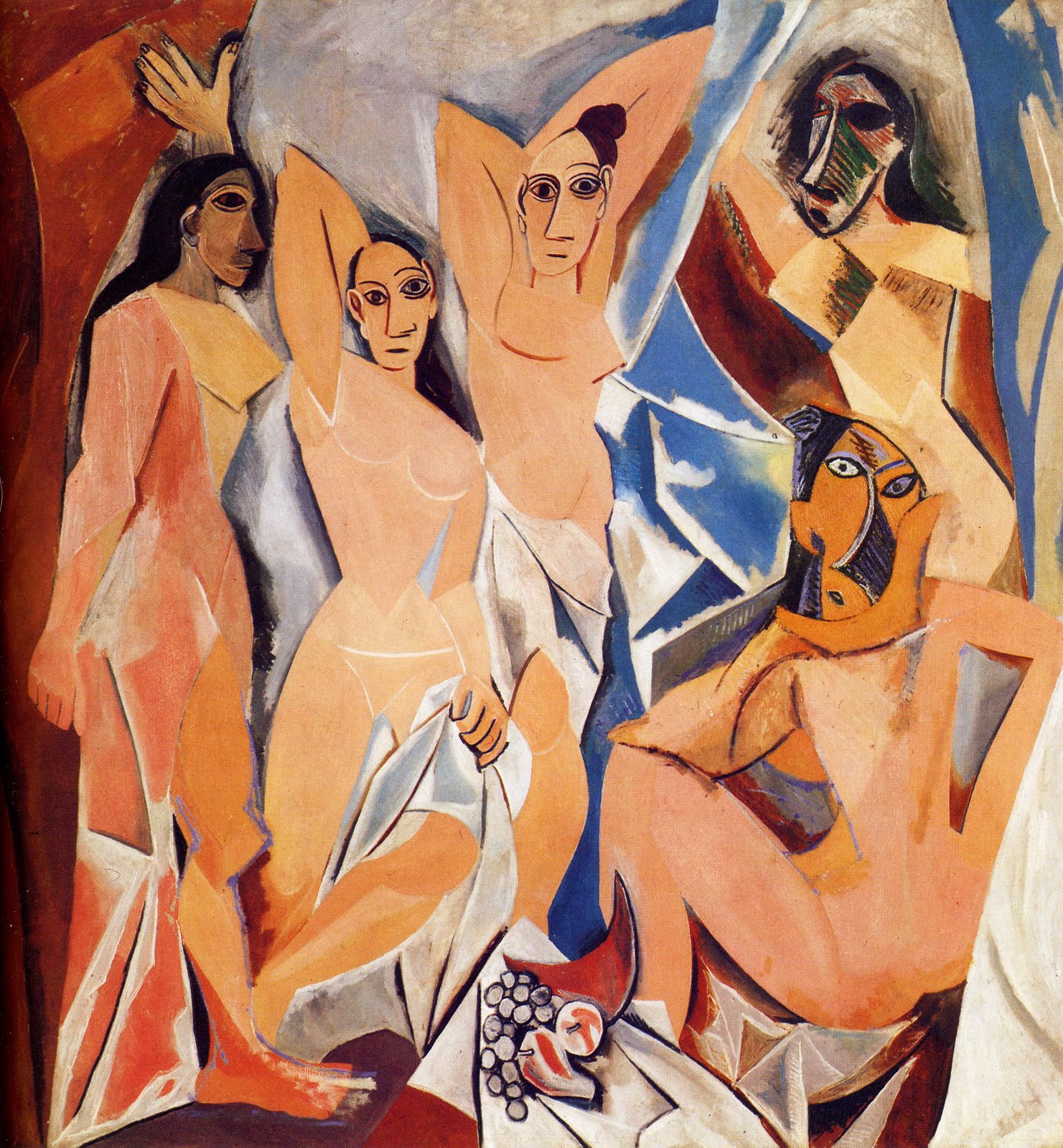
Pablo Picasso - Les Demoiselles d'Avignon
Pablo Picasso – Les Demoiselles d’Avignon

The work’s significance lies in its demotion of the nude to an earthbound status that would eventually reach the peak of its final metamorphosis in Pablo Picasso’s Les Demoiselles d’Avignon (1907).  A comparative study of Picasso and Cézanne is not new. Imagine how many Ph.D. theses had been devoted to the topic.

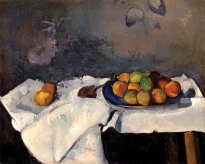
Still Life: Plate of Peaches, 1879-80. Oil on canvas, 59.7 x 73.3 cm. Solomon R. Guggenheim Museum, New York, Thannhauser Collection, Gift, Justin K. Thannhauser 78.2514.4
Still Life: Plate of Peaches, 1879-80. Oil on canvas, 59.7 x 73.3 cm. Solomon R. Guggenheim Museum, N.Y.

Cézanne set up his still lifes with great care. A testimony by an acquaintance describes his method of preparing a still life: “No sooner was the cloth draped on the table with innate taste than Cézanne set out the peaches in such a way as to make the complementary colors vibrate, grays next to reds, yellows to blues, leaning, tilting, balancing the fruit at the angles he wanted, sometimes pushing a onesous or two-sous piece [French coins] under them. You could see from the care he took how much it delighted his eye” (But when he began to paint, the picture might change in unusual ways. Cézanne seems to be painting from several different positions at once. He believed that the beauty of the whole painting was more important than anything else—even more important than the correctness of the rendering (Robert Burleigh, Paul Cézanne: A Painter’s Journey [New York: Harry N. Abrams, Inc., 2006], p. 18).

Inevitably, we see him as the point where modern art began: so the first room of thecezanne1 (2) Museum of Modern Art in New York, in its current hang, gives us a Gauguin and three Seurats on the left; outnumbering them, on the right and straight ahead, are half a dozen Cézannes. But, just as inevitably, in his own time they could see more clearly where he came from than where he would lead. So a friendly critic called him “a Greek of the Belle Époque”. Renoir said that his landscapes had the balance of Poussin, while the colours in his “Bathers” “seem to have been taken from ancient earthenware”. Cézanne, like all serious members of any artistic avant-garde, was constantly learning from previous masters, studying Rubens all his life. And while we might admire his daring fragmentations of vision, what the painter himself sought was “harmony”, which was nothing to do with “finish” or “style”.

Cézanne had his first one-man show in 1895, at the age of fifty-six.cezanne4

Sources: http://www.artic.edu/                                                               http://arthistory.about.com                                                           http://www.guggenheim.org/new-york/education