
 Because who’s managing our online reputation?
Taken from an article by James Dolan in the Technology section of Nuvo Magazine.
It’s amazing that we have the ability to talk to, learn from, and work with people from all over the world – from the comfort of our home. The liberty to exchange opinions, explore new ideas, the freedom to do what you want, say what you want, be who you are, without the government, the boss, or mom and dad getting in the way.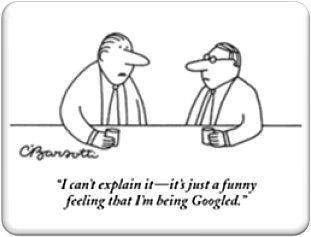 In practice, the freedom by the Internet has proven something of a double-edged sword. True, the combination of anonymity and interconnectivity has allowed millions to enjoy unprecedented freedom of expression. Out of that…
Gossip, misinformation, unverified rumour, tall tales, bald-faced lies – all of it can be found in plentiful on the Internet. With the rise of Facebook, Twitter, and other sites as the 21st century’s communication medim of choice, It seems we can all look forward to the badmouthing growing in frequenty and expanding in volume, cached on countless servers until the end of time. Or at least until we run out of hard drive space.  Now that the Internet has developed into a powerful tool for the pursuit of wealth as well as happiness, the fabrication of untruths has become a viable business strategy. In an environment where what people say about you (and how they say it) can make the difference between profit and loss, it is easy to imagine how such activity could be used for less-than-pure-purposes: a positive review to falsely promote a brand’s reputation; a negative review to destroy it.
Uncomfortable with the “anything goes” culture of user-generated content, many popular websites have taken their own approach to protecting and policing the reputations of users. Auction site eBay encourages users to leave feedback; tech blog Slashdot has developed the concept of “karma points”; and last year search giant Google launched a toolset to help users request expedited removal of confidential or unwanted content.
There is also professional help. For a fee, a reputation manager will monitor online activity and defend one’s cyberstanding from the slings and arrows of muckrakers and hacks. Part public relations officer, part computer engineer, part private eye, such specialists are quickly becoming essential staff members for celebrities, politicians, high-profile athletes, and multinational corporations looking to cure themselves of bad press.
There is no denying that the Internet at times resembles a giant high school, where mean-spirited children (of any age) can mock, tease, and intimidate without the fear of reprisal. By eliminating our ability to criticize and scold, to bitch and complain, to shake our collective fists at injustice both imagined and real, we lose no small part of that freedom we were once promised. Slowly but surely, truth comes to resemble our reputations: something no longer earned, but “managed”.
 Girl Who Would be KING on Life, Style and INSPIRATION.
You must be logged in to post a comment.