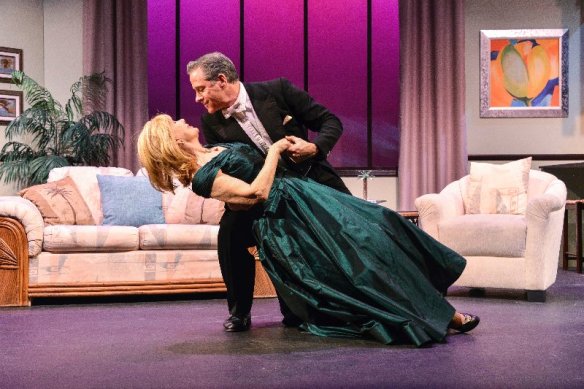
A NEW SPIN ON A TIMELESS COMEDY

Father Tartuffe: An Indigenous Misadventure is playing at the Arts Club Theatre in Vancouver until March 24th, 2024.

Every now and again I may invite a guest reviewer on this site.  Today it is Paul LeMay who I’ve asked to give his take on “Father Tartuffe” from the opening night at the Arts Club Theatre.  

The arts (theatre, poetry, music, painting, sculpture, literature, dance) done with skill and imagination, are an essential part of life.

Paul’s Review:

Father Tartuffe: An Indigenous Misadventure is built around a play called Tartuffe, or the Impostor, originally written by Jean-Baptiste Poquelin, who is better known as Molière. Molière, who lived during the reign of France’s King Louis XIV, is often described as France’s Shakespeare. However, unlike the Bard, Molière preferred comedic plays.

And comedy is the operant word here, which is important when one considers the times in which the play is being performed. I refer here to several world headline grabbing allegations made in recent years by certain First Nations spokespeople about the abuses and yes, possible crimes indigenous students allegedly suffered at the hands of unscrupulous clergy in Canada’s various denominational native residential schools. So, given the huge social controversy these stories sparked, what could possibly be considered comedic diving into that terrain?

And perhaps that’s the inescapable point worth mentioning here. Many of European settler ancestry might be inclined to believe this play might be all about pointing many accusatory fingers at the perpetrators of cultural genocide against first nations peoples, and the legacy of harm it unleashed in its wake. And who would want to squirm in their seats for two hours in some in unrelenting guilt fest? I have to admit, these were some of the thoughts that crossed my mind before attending the performance.

Well, I am here to tell you that’s not what indigenous  playwright Herbie Barnes did. Rather, the play took a much more light-hearted aim at the immoral character of an exploitive Montreal priest by the name of Tartuffe, which was entirely in keeping with the original Molière play title. Tartuffe had been invited to live in the home of an extended first nations family, that was itself already in the process of trying to find out what it meant to be an “Indian” in 1967 Canada. Sure, in some respects one could argue that the Tartuffe character was a symbolic stand-in for the duplicitous white man who speaks with forked-tongue. But for many, that allusion might completely escape their immediate recognition.

Yet both the play, and its performers, did not disappoint. In fact, on both counts, both exceeded my original expectations; and it accomplished what it set out to accomplish, namely, to make people laugh.  And laugh we did, even at jokes filled with all manner of culturally riské inuendo, that tastefully never quite crossed the line into taboo land. From my eyes, the play was part situation comedy, part farce, part inside jokes among native people, and together, the mix proved cathartic, if not, therapeutic.

And as the ancient Greeks knew long ago, this can help audience members (society’s members) both explore and release pent up guilts and/or mental tensions around almost any topic, in the hope they realize that we are all flawed individuals trying to make our way through life the best way we can…even screwing up on occasion despite our best of intentions. And this alchemy succeeds because such is the universal human condition. In this respect, this play and its performers, proved both healing and entertaining. What more can one ask of a play? In this regard, it was an evening well spent.

February 28 to March 24:

 To book:

https://artsclub.com/shows/2023-2024/father-tartuffe-an-indigenous-misadventure

Six Dance Lessons in Six Weeks

Notice how as the sunset is coming to an end the colours become even more intense, brighter and vibrant? – paraphrasing a line from the playdancelesson1

I just saw a wonderfully thought out play about life, unlikely friendships, loneliness and aging presented by Coyote Stageworks at the Annenberg Theatre, which is part of the Palm Springs Art Museum.  Six Dance Lessons in Six Weeks warrants discussion on several life issues such as what it’s like for a woman living alone, toleration and discrimination but with exceptionally witty dialogue.

The play stars Loretta Swit (most recognizable as Hot Lips Houlihan from M*A*S*H TV series) and Broadway Actor David Engel, both of whom I met recently at Village Fest while I was out walking my two dogs among the madness. Infact, I found out about this play from Loretta Swit. Coincidentally and funnily enough when I called to tell my husband about meeting her, he was at home watching an episode of Mash.

Michael (David Engel) teaches Lily (Loretta Swit) how to dance
Michael (David Engel) teaches
Lily (Loretta Swit) how to dance

Swit plays Lily, an elderly widow who hires Michael (Engel) a gay dance instructor to come to her home to give her lessons from Tango to Swing to Viennese waltz.

Both actors compliment each other incredibly well and are really fun to watch amidst some enjoyable dance moves.  They lie and they argue but ultimately they share more similarities than not and what enfolds is revealingly heartfelt. The audience also enjoyed two stagehands who entertained us while swiftly re-arranging the room in between each of the scenes.dancelesson3

They plan to take the play on tour.  When it comes to your city I highly recommend seeing it.

Have you seen any good plays lately?

http://www.coyotestageworks.org

PhotosBroadwayWorld.com

Style ICON: woman of substance – Charlotte Rampling

I’ve always been attracted to Charlotte Rampling but not in that way…

 Photo: Philip Sinden
Photo: Philip Sinden

…because she embodies that wow factor in the same admirable fashion that Cate Blanchett does and Katherine Hepburn did. Very attractive but not in a conventional sense, in a much more interesting manner, smart, confident, a talented actor and so very chic – her own stylishness. Her stage play Neck of the Woods just wrapped at HOME, Manchester, as part of the Manchester International Festival on July 18.

Rampling on…

Words with Charlotte Rampling – on working with wolves, the power of the audience and what she means when she calls herself an artist.

Who’s afraid of the big bad wolf? We all are, it seems.

Charlotte Rampling on the WOLF
“I think humans have a very profound relationship with animals. Wild creatures are more mysterious to us – we can’t actually approach them so that makes them enigmatic, that’s why we study them and do art pieces around them. There is a lot that goes in people’s imagination about wolves, starting from the basic stories we hear all the time. There is a particular fascination – from the thought that one must be scared or wary of them, to the cultural idea of ‘the big bad wolf’. They have a strange character, they are mysterious, maybe more so than other animals.”

Charlotte Rampling on the power of the AUDIENCE
“The study of an audience is very important. We are doing it for them so we want to get the best possible angle for them, and to bring them in. You feel when an audience is getting distracted or not quite following, and then you have to really start to understand why they are not with you. Yes, I think that is what live performance is about; you are facing an audience and you are saying it to them. It is not like you are in a play and playing to the people you are playing with; here you are playing to the audience so you must have them with you at all times. If you don’t – well, they are like a pack of wolves and they will take the play away from you if you are not careful. They will turn it into something other. If you let the audience go, you have lost the moment, and essentially you have lost the play.”

Charlotte Rampling on being an ARTIST
“All my life I have followed the thought that if I have already done something, why would I then want to do it again?” So unless the film is really intriguing then to me, it is just another film. I have always gone off the track and have looked at things that I can do that will allow me to see the world in a different way. It is just a basic form of curiosity on my part, to want to discover something and find another way of doing things. What I found is that as you get older your mind actually doesn’t get any older, you just get older physically and you obviously have more experience. Now that I am working with a lot of younger artists, it is very intriguing, as I am able to bring my life with me to the stage. There is a young French artist I am working with called Loris Gréaud. We did a film together with David Lynch called The Snorks, which was an extraordinary project based around animals that live so far underneath the sea that no one has ever seen them and they let out energy through electrics. The relationships that you have with other artists after you have done all these projects brings you into another world, and to me that is what living creatively is all about. I am not an artist per se even though I would love to be, I don’t do sculptures or the like as that is not my profession but I know that I can infiltrate what I have into the works of others.”

As told to Tish Wrigley for anothermag.com