The TORONTO INTERNATIONAL FILM FESTIVAL is in full swing and celebrating 50 years. Happy Anniversary TIFF! This is my second time at this amazing Festival of Festivals (it used to be called that) and it truly is a feast for any film lover with so much to choose from.
“All that matters has already been written” – George Orwell’s last words, at the age of 46, nearing death from tuberculosis.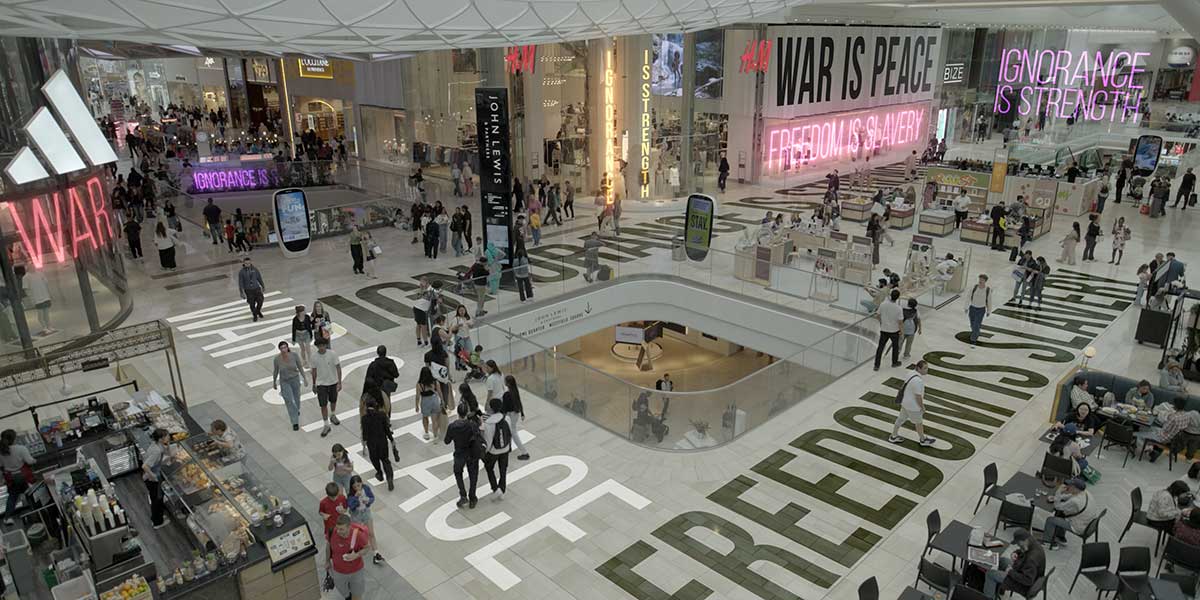
My first film before spending 4 nights in Montreal to visit family, was the North American Premiere of 2+2=5. It was approved for a documentary by the Orwell family. I was hesitant at first because I knew it would be heavy and somewhat depressing – just like some of the books I read in high school that Orwell wrote – specifically “1984” and “ANIMAL FARM.” Although totally unrelatable at the time, I was truly fascinated by those books. But now, sadly; they’re relatable!
“2 + 2 = 5” is a metaphor for forced belief in falsehoods. It shows how a totalitarian regime can manipulate reality and demand obedience; not just in actions, but in thoughts. If the Party says 2 + 2 = 5, then you must not only say it, but believe it. It’s about breaking down your ability to trust your own logic and senses. It comes down to crazy making psychological control.
If all that matters has already been written, then why bother writing at all?
Maybe because the writer’s task is to say it better, clearer, or more urgently. Don’t count on me for that. Orwell certainly did that, as his work still punches through decades later – his books are a nod to the idea that the past holds the keys to understanding the present – and that ignoring it is dangerous.
Was Orwell an unfortunate teller? Or maybe from another planet, sent to give us mere earthlings warnings of what may come if we allow it? You’ve gotta wonder.
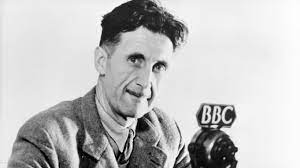 George Orwell wrote 1984 in 1949 as a warning, not a blueprint. He had witnessed the rise of totalitarian regimes such as Stalin’s USSR, Hitler’s Germany, and the manipulative propaganda of wartime Britain. His goal was to expose how language, surveillance, and psychological control could be weaponized to crush dissent and rewrite reality.
Orwell warned of a world where truth is manipulated (think how the media is operating) and how fear keeps people in line. In the book 1984, the protagonist, Winston, works at the Ministry of Truth. His job is to alter historical records, erasing inconvenient truths and replacing them with Party-approved versions. Quite chilling.
Makes you wonder what the actual truth is sometimes.
Even though this documentary was about Orwell, there were other authors who also wrote dystopia fiction and philosophical resistance to authoritarianism and such:
Aldous Huxley (BRAVE NEW WORLD) imagined a society where people are pacified by pleasure and distraction. Pleasure as control, consumerism, loss of identity.
Ray Bradbury (FAHRENHEIT 451) about censorship and intellectual freedom.
H.G. Wells (THE WAR OF THE WORLDS) is a classic example of dystopian fiction, and one of its simplest and most chilling illustrations of dystopia is this:
One day, without warning, giant alien machines descend from the sky. They’re far more advanced than anything humans have ever built. They don’t communicate. They don’t negotiate. They just start obliterating cities, vaporizing people, and harvesting humans like cattle. Society collapses almost instantly. Governments fail. Technology is useless. People flee in terror, and survival becomes the only goal. Talk about chilling! And more recenty…
Margaret Atwood (THE HANDMAID’S TALE) about gender, power, and resistance.
These authors didn’t just write fiction—they wrote philosophical warnings. Each one tackled the question of how societies can be shaped, controlled, and ultimately dehumanized.
How does this resonate with today? These versions aren’t just relics of the past – they feel like blueprints for dissecting today’s world, by recognizing the tension between individuality and conformity.
They’re like flashlights in a foggy digital age. They tackle:
Mass surveillance: Governments and corporations track digital footprints – think facial recognition, data mining, and predictive algorithms.
Disinformation: “Fake news,” deepfakes, and algorithmic echo chambers mirror Orwell’s “doublethink” and “newspeak.”
Censorship & control: In some regimes, dissent is criminalized, and history is rewritten – Ministry of Truth lives on.
So was 1984 a warning or a manual? It was unquestionably a warning, but one so precise and psychologically astute, that it inadvertently became a toolkit for control.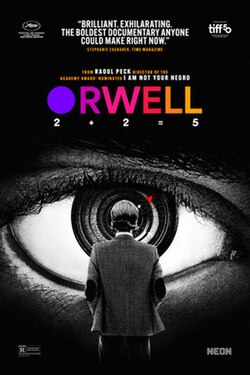
About the film:
Oscar-nominated filmmaker Raoul Peck (I Am Not Your Negro) takes a deep dive into the writing of George Orwell (1984) to explore its potent relevancy to our current times.
George Orwell titled his dystopian 1949 novel 1984, but it feels utterly current in 2025 when phrases like “Big Brother is watching you” might refer to Big Government, Big Business, or Big Technology. Orwell is overdue for a fresh look and filmmaker Raoul Peck makes for an incisive and stirring guide. Peck has long put great writers at the centre of his work, most notably in his Oscar-nominated documentary I Am Not Your Negro about James Baldwin.
“I knew that I had a facility with words and a power of facing unpleasant facts,” Orwell wrote. Those simple assets carried him far. While he’s best known as the author of Animal Farm and 1984, this film opens us to a wider range of his writing that drew from his personal experience of poverty in Down and Out in Paris and London, of colonialism in Burmese Days, and of revolutionary uprising in Homage to Catalonia.
Peck pulls lines and impressions from these works and others, enlisting British actor Damian Lewis to embody the voice of the author. Visually, Peck uses film footage from multiple adaptations of 1984 and Animal Farm. He layers in contemporary news and documentary footage to evoke the alarming rise of totalitarianism, surveillance, and government violence in our present day.
It’s both conversely reassuring and frightening to see how much analysis Orwell brought to what we’re experiencing today. –THOM POWERS
TIFF is on until September 14th, 2025:
 Girl Who Would be KING on Life, Style and INSPIRATION.
You must be logged in to post a comment.