

The D-lemma: Are you getting enough?
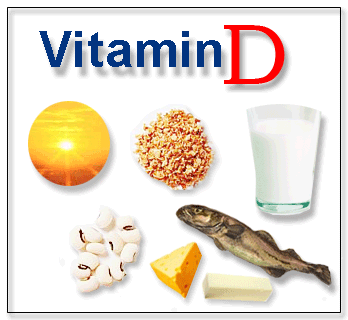
Even though the nutrient is available in supermarket staples and via sun exposure, many of us don’t get enough.
Technically it’s a vitamin, but it behaves more like a hormone, in that the body can create a certain form of vitamin D through exposure to sunlight. And yet, according to nutrition researcher Walter Willett of the Harvard School of Public Health, an estimated one in three Americans of European descent suffers from a deficiency of this vitamin. Vitamin D is vital to bone health and may also support immune function and prevent certain cancers, diabetes, multiple sclerosis, heart disease, and even the common cold.
So if it’s found in readily available foods, and a mere 5 to 10 minutes a day of sun exposure generate enough Vitamin D for most people, what exactly accounts for such widespread deficiency? Willett blames a whole host of factors: Over the centuries, people have migrated away from the equator and are exposed to less sunshine; industrialization has pushed many occupations indoors; and then there’s that aggravating habit, he jokes, of “putting on clothes, which blocks the sun light.” More recently, of course, we’ve been slathering ourselves with sunscreen.
And since the blood test that pinpoints vitamin D levels is expensive and not routinely given, many people have no idea their levels are low. Symptoms that might prompt your physician to order the test: lethargy, muscle aches and pains, clumsiness and frequent falls, and bone fractures from small stresses.
How much do we need?
Adding to the confusion is the debate over the recommended daily allowance. In 2010 the recommended daily amount of Vitamin D for adults was 600 IUs – but according to clinical trial results published in 2012 in the New England Journal of Medicine, 800 IUs a day improve protection against broken bones by 30 percent. D helps the body absorb and retain calcium and phosphorus – critical bone builders – which is reason alone to err on the side of more IUs. Willett recommends most adults get 2000 IUs daily. Don’t worry about taking too much – it takes several hundred thousand IUs to reach toxic levels.
If you expect sunshine to provide you with vitamin D, then make sure your shadow is shorter than your height. The long shadow we see in November is proof the sun is not doing it for us any more, and it’s time to take care of ourselves.
Reinhold Vieth, PhD#
– See more at: http://www.vitamindday.net/tag/vitamin-d-quotes/#sthash.WgVkxY77.dpuf
Ways to get more Vitamin D
One simple solution – take a supplement.
The Sun for 5-10 minutes/day – 3000 IU
1 Cup of Vitamin D fortified Orange Juice – 137 IU
3 ounces of cooked Sockeye Salmon – 447 IU
1 Large Egg Yolk – 41 IU
2 Sardines canned in oil – 46 IU
1 cup of vitamin D fortified milk – 120 IU
Typical Multivitamin – 400 IU
Whether you hate the sun or love it, you can and should get enough Vitamin D.
Taken from “How-To-Handbook” in Health section of “Living” by Sally Schultheiss
If you expect sunshine to provide you with vitamin D, then make sure your shadow is shorter than your height. The long shadow we see in November is proof the sun is not doing it for us any more, and it’s time to take care of ourselves.
Reinhold Vieth, PhD#
– See more at: http://www.vitamindday.net/tag/vitamin-d-quotes/#sthash.WgVkxY77.dpuf
If you expect sunshine to provide you with vitamin D, then make sure your shadow is shorter than your height. The long shadow we see in November is proof the sun is not doing it for us any more, and it’s time to take care of ourselves.
Reinhold Vieth, PhD#
– See more at: http://www.vitamindday.net/tag/vitamin-d-quotes/#sthash.WgVkxY77.dpuf
**Don’t miss listening to “Transforming Health” with host Brad King for the most evocative and informative up-to-the-minute interviews with leading health professionals – Live every Wednesday @ 12PM-PST/3PM-EST on VoiceAmerica.com – #1 internet radio station in North America.
Here’s the link: http://www.voiceamerica.com/show/1686/transforming-health

 Girl Who Would be KING on Life, Style and INSPIRATION.