Beauty: my sister went to Morocco and brought me back liquid gold…

Recently and straight from the source – oil that is! Moroccan Argan Oil from the Atlas Mountains. On a camel no less…

and took a Selfie
and took a Selfie to prove it

In recent years, an incredible oil from Morocco called Argan oil (Argania spinosa) has become such a hot commodity that a New York Times editorial termed it “liquid gold.”

“I love gold and I definitely love a beauty product with multiple purposes.”

Most women are familiar with the hot selling Moroccanoil haircare products that pioneered a new category in the beauty industry. You can hardly walk by a hair salon that doesn’t sell it. The products are infused with nourishing antioxidant-rich argan oil.  Moroccanoil has grown into an iconic beauty brand in less than a decade.

I do not know what amount of argan oil is inside each of their products, but Argan Oil (extracted from the nuts of the fruits of the Argan tree) in general is an all around multi-use product with curative properties revered for centuries in Morocco, the only place where the Argan tree is naturally found . In the southern regions of the country, pure Argan oil is celebrated for everything from soothing skin redness to curing rheumatism and more.
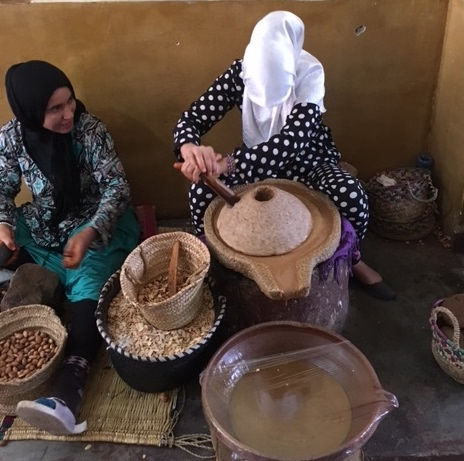
Women preparing the Oil

You can use it on your skin, you hair, your nails and even cook with it (using a different variant of the oil my sister has informed me). See below.

I’ve been sourcing out healing oils from all over the world for the face oil used in my own skincare line.  Many of which I’ve researched and found from my very own travels – for “Skin so Divine” and Argan was included in the mix.  Before this  I bought the Josie Maran Argan Oil at Sephora because it was the only one I could readily find that admits to being 100% pure.  But at $60 for 1.7 oz/50 mL it can get quite costly.  And that’s only for one oil. It’s the rarity of this Moroccan oil that makes it more expensive than most others.
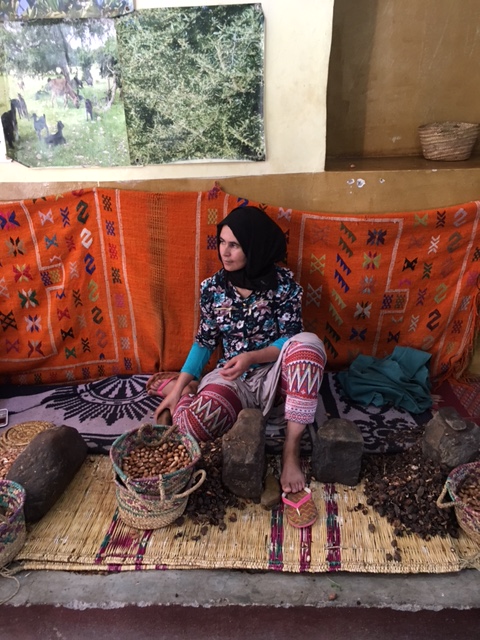
Nuts from the Argan Tree
Nuts from the fruit of the Argan Tree

For face it’s rich in vitamin E and essential fatty acids to deeply hydrate and nourish skin.

Traditional Uses of Morocco’s Golden Oil

Traditionally, Argan oil has been used topically to:

Protect against and heal skin infections
• Clear up acne
• Ease eczema
• Hasten recovery from chicken pox
• Heal cracks and burns

One of the Rarest and Most Unique Oils in the World

The Argan tree is known throughout the Berber state in Morocco as the “Tree of Life.” Pure Argan oil is made from the kernels of the nuts from argan trees.

Atlas Mountains
Atlas Mountains
The Tree
The Tree

Today, Argan trees grow exclusively in the semi-desert soil of the Arganeraie Biosphere Reserve. Due to this small and specific growing area, the trees are protected by the United Nations Educational, Scientific and Cultural Organization (UNESCO)—and pure Argan oil is one of the rarest in the world.

The pure Argan oil industry is almost as unique as the oil itself. All Argan sold today comes from cooperatives operated by Moroccan women (see bottom for more info.), and the cooperatives share profits among the local women of the Berber tribe. The money goes toward health care and education, as well as other good works. For example, Argan oil profits established an ecosystem reforestation project so that Argan can be sourced conscientiously and the supply will not run out.

Even more incredible is that revenues from pure Argan oil sales are reported to feed 10% of the Moroccan population.

Wonderful for Skin, Hair, and Nails…and the World

“Recent scientific studies have shown that the benefits of Argan oil has antimicrobial properties, and can be used in treating damaged skin and inflammation,” said Majda Alaoui Sosso, director of one of Morocco’s oil cooperatives.

This is in part due to Argan oil’s rich stores of essential fatty acids, or EFAs, which support the health and beauty of skin and hair (while also, when taken internally, boosting heart and brain health and regulating hormone levels and other critical functions).

Pure Argan oil is easily absorbed, and it regulates the pH balance of the skin, which in turn protects against sun exposure and other damage. It also reduces skin inflammation and thus helps control and reverse skin disorders such as eczema and psoriasis while also diminishing scars.

Pure Argan oil’s proven and observed benefits for hair, skin, and nails are extensive, and include, to name a few…

  • Dry Skin: Nourishes and moisturizes dry, scaly, flaky skin and protects against infection.
  • Oily Skin: Regulates sebum production to keep the skin’s natural oils at a healthy level. With regular use, the skin will no longer look or feel oily.
  • Irritated/Itchy Skin: Protects skin from allergens that may cause itchiness.
  • Acne: Controls overproduction of acne-causing sebum and soothes the inflammation brought about by acne; also prevents the ugly scars acne can leave behind.
  • Aging: Stimulates renewal of skin cells and boosts elasticity while smoothing wrinkles and lines.
  • Sun Damage Rich in antioxidants that protect cells from UV light.
  • Eczema and Psoriasis: Helps alleviate inflammatory symptoms associated with psoriasis. Also addresses immunity problems and allergies that trigger eczema symptoms.
  • Hair: Repairs damaged hair. Moisturizes instantly, and prevents split ends while restoring shine. Increases hair growth and helps control, cure, and prevent dry and itchy scalp.
  • Scalp: Keeps scalp healthy and well nourished. A few drops will protect against dandruff. Keeps the roots of the hair hydrated, protected, and well nourished.
  • Nails: Keeps nails strong and healthy and restores natural shine while easily resolving brittle nail problems.

I made up some little bottles of the pure oil to use on its own as well as combined it with the other essential oils which make up the Divine Facial Oil…which by the way, is simply divine.

Thank you Lisa  XOXO x 10  (also for the authentic Moroccan Tagine which I love).

Photos: Lisa King

Another Selfie with a close friend. Step aside Kim!

IN THE KNOW: the tree + production for Argan Oil:

Argan trees live for about 15-200 years and grow up to be nearly 30 meters in height. Around the 30 or 50 year mark, the trees start producing fruit. The trees yield fruit once a year and one tree will usually yield 1 liter of Argan Oil. One liter of oil takes 10 to 12 hours of manual work to make!

The production of 100% organic Argan Oil is a complex, labor intensive process. The Argan fruit is harvested and the peel and the pulp are discarded. What is left is a hard-shelled, oval nut which is cracked by hand. The emerging kernels are ground into a paste from which oil is cold pressed. The freshly extracted oil may be left to sit for 2 to 3 weeks after which clear oil is poured into dark bottles and exported around the world.

This harvesting and cold pressing is done by local women from the Berber tribe of Morocco who are organized into co-operatives. Fair-trade Argan Oil provides Berber women with a stable source of income, financial independence and better opportunities for education, health and personal development.

More than two million people rely on Argan trees for economic sustenance and the Argan Oil trade has reformed the entire region by providing access to a stable income.

Culinary Argan Oil

The culinary variant of the oil is produced by roasting the nuts first and then grinding them to a sticky paste where the oil comes out of. By roasting the oil gently, it will get a deep nutty aroma and flavor. The oil is very good for the heart and brains as it boasts a healthy rich array of omega-3 fatty acids and 3 times more vitamin E than olive oil. It is also amazing for digestion and can be sprinkled on salads, grilled fish & meat stews to get a delicious nutty flavor. I have some of this too. UPS: cooking oil varieties.

Source (in part): underground health reporter, Lisa King & myself

Style: what we make of it

Do you ever wonder how we develop a so-called Style?

Faye Dunaway and Warren Beatty in Bonnie & Clyde
Faye Dunaway and Warren Beatty in Bonnie & Clyde – makes me want to rob a bank!

What does having style really mean? Does it start from childhood or develop later in life? How much does our upbringing have to do with it, from our parents first dressing us to peer pressure and beyond? Do we dress in a way that shows rebellion, sophistication, trendiness? Do we dress to impress? How much of what we see in magazines /the internet influence us?  Does having a style come naturally or does one work at it?  How much time do you spend thinking about what to wear every day or evening? Do you just get up, get dressed and go, or spend serious thought time planning how you want to appear each day?  Or do  you wear a uniform? Do you think that spending a lot of money on an item makes you look better? Is wearing vintage cool or just a better word to use instead of saying you shopped second hand.  Do you dress for yourself or for someone else? Does your dress style carry over to other areas….like for instance basic lifestyle choices in art, food, décor and beyond?

Style Icons Karl Lagerfeld, Coco Chanel, Diana Vreeland & Yves Saint Laurent.

Just questions to start a conversation.  It can get complicated because it’s personal and what works for someone and how they can carry off a certain look might not work at all for someone else.  Real style cannot be taught but it can be innate and/or developed over time (think Princess Diana & Kate Middleton). Money and Stylists certainly help but these women already had a keen sense of it to begin with.

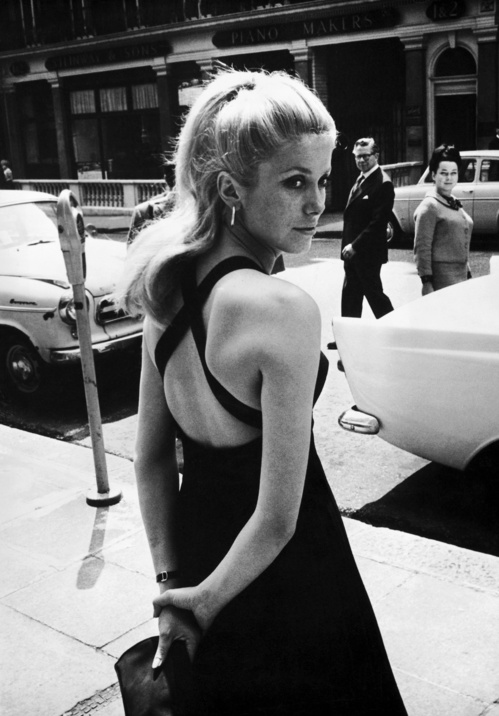
Deneuve
Catherine Deneuve in a head turning LBD

Probably some of my favourite role models (icons) would be the likes of Audrey Hepburn (I mean who else could make cropped pants & flat shoes look so chic?), Grace Kelly, Lauren Hutton, Jackie O, Coco Chanel, Catherine Deneuve & Kate Moss.  I love the polished looks from Palm Beach society women to Michelle Obama.  I can go from simple Chic to Princess Chic.  No, but really; my favourite look is classic, comfortable but individual and never boring (although sometimes….).  Accessories and fabric have become more important but I tend to appreciate anyone’s (regardless of age, social income or gender) overall style if it’s unique to them and flattering.  I think herein lies the true meaning of “Style”  –  not copying someone else but interpreting a style your own way and putting your own signature on it.  Your own personal style.  Real style transcends the ages.

The twins, Grace Kelly, Iris Apfel
STYLE – they all have (had) it! Mary-Kate & Ashley Olsen (of the ROW) Grace Kelly & Iris Apfel

So thought I’d share some thoughts from famous designers/people who have words to say about life + style.  Maybe we can understand how they choose to evolve their brands a little better by interpreting what they believe the customer (us) wants.

Designer Philip Lim

His seamstress mom was salt of the earth and could make anything with her hands.  His dad was a professional poker player ( I don’t know why but I found this quite intriguing).  He grew up in conservative Orange Country and his dad used to pick him up from school in a pimp mobile when other kids were getting picked up in station wagons, etc.  But he was successful at poker and it was what he wanted to do so………..we can judge.  We tend to judge.

On what he loves most about making clothes…
“What I love the most about making clothes is that clothes are the most powerful expression of self. Because no matter where you come from, no matter how you got there, no matter where you are, you put on the right clothes, you can be anything you want. In a world where people judge, let’s admit, judge all you want, because I got it! Not me, but it’s true, when you wear something beautiful, judge me, look at me, at least you’re looking at me. It’s true.”

Designer Derek Lam (His New-York based ready-to-wear label enjoys a loyal following of downtown types)

“I try to capture what the customer is excited by, what she is intrigued to travel toward, and make that my approach to designing.”

Designer Marc Jacobs

Real fashion is something you don’t need, it’s something you want.” He can’t really say what makes his fashion work.  “It’s all about creative choice.”  “Sometimes the design team inspires me and brings in things they’re interested in.  I think, Oh, I’d like to use this.  Other times I don’t know what I want.  It’s a magpie aesthetic: If something is hideous, that’s interesting.  It’s kind of the same sensibility that Andy Warhol had.  He was interested in everything and soaked up what he saw like a sponge.”

Designer Carolina Herrera

“Glamour is beyond beauty and beyond age.  It’s like sex appeal.”  “Fashion is magical, a fantasy.  It’s madness, and it doesn’t last.  It’s changing all the time.”

Jane Birkin –  actress, singer, muse.  Namesake of the popular Hermès Birkin bag.

Photo: Courtesy of The official Saint Laurent Twitter page / @YSL

For years her look oscillated between jeans with a white shirt tied at the waist and a mini dress paired with thigh-high boots.  Funnily enough her omnipresent accessory was a wicker basket which became her calling card.  That is until her then boyfriend, the director Jacques Doillon ran over it with his car…on purpose. He said “It’s terrible for you to be known for your object.”  But good fortune struck again in 1981, when, while rushing for a flight, she spilled the entire contents of her replacement pouch in front of Hermes chairman Jean-Louis Dumas.  They started chatting and she said “You should do the Kelly bag, but three times bigger and not shut it.”  He was intrigued, so she drew on one of those vomit bags and said “Can you make it for me?” The rest, as they say, is history.  Thirty-five years later, the Birkin bag is still one of the most in-demand accessories in the world.  And in case you were wondering, the namesake of the Birkin bag only owns one. All the others were put up for sale for Amnesty International, and Anno’s Africa about 10 years ago.  Her influence extends well beyond the fashion realm.  Yet the industry is always watching, trying to capture her effortless joie de vivre and spirit into its own collections.  You’d be hard pressed to find a style blog (ahem, ahem) that doesn’t feature her as its all-time favourite poster girl.  This past March she appeared in Saint Laurent’s Spring 2016 ads shot in stark black-and-white wearing a white button down shirt and a black le smoking blazer.

Kate Middleton, Sienna Miller, Jackie O & Madonna - individualism.
Kate Middleton, Sienna Miller, Jackie O & Madonna – Individuals who have (had) a look and set trends.

Where the gang make their getaway:

Designers pack their bags for resort, staging runway shows that span the globe in some of the world’s most picturesque and Instagram (very important) friendly locations.  At Louis Vuitton, Nicolas Ghesquière opted for a futuristic backdrop, Oscar Niemeyer’s Niterói Contemporary Art Museum, which is perched on a cliff overlooking the bay in Rio de Janeiro.  The U.K. got a double dose of fashion with Dior and Gucci.  Dior’s guests partied at the London pop-up pub the Lady Dior and the following day boarded the chartered Dior Express train for the show at Blenheim Palace in Oxfordshire.  Archival looks from Christian Dior’s famous presentation there, held in 1954, as well as of the 1958 outing by Dior’s successor Yves Saint Laurent, were on display.  Gucci’s Alessandro Michele brought his punk-Victoriana collection to a church: Westminster Abbey, filling the front row with starlets including Elle Fanning and Kate Mara.  (resort by Lauren McCarthy for Bazaar Magazine).

Why?  For more style inspiration!  Because they must keep things alive, cool and hot at the same time. Because maybe we haven’t seen it ALL before.

With travelling and depending where, we gather fresh and different ideas about the way people dress.  We love to find unique items where people will ask “where did you get that?” All in the name of Fashion…which goes a long way towards helping us improve our Style so things never become Boring.  Does that make sense?

I know I haven’t really answered any questions here….because there are no set answers.  It’s just fun to think about and play around with.  It’s why we love to dress up once in a while, it’s a chance to show a different side of ourselves… a grown up side, a naughty side, a business side, a crazy side.  Aside from all that,

How do YOU define style?

Source for Jane Birkin: Bazaar Magazine

Food: what’s gourd for Fall

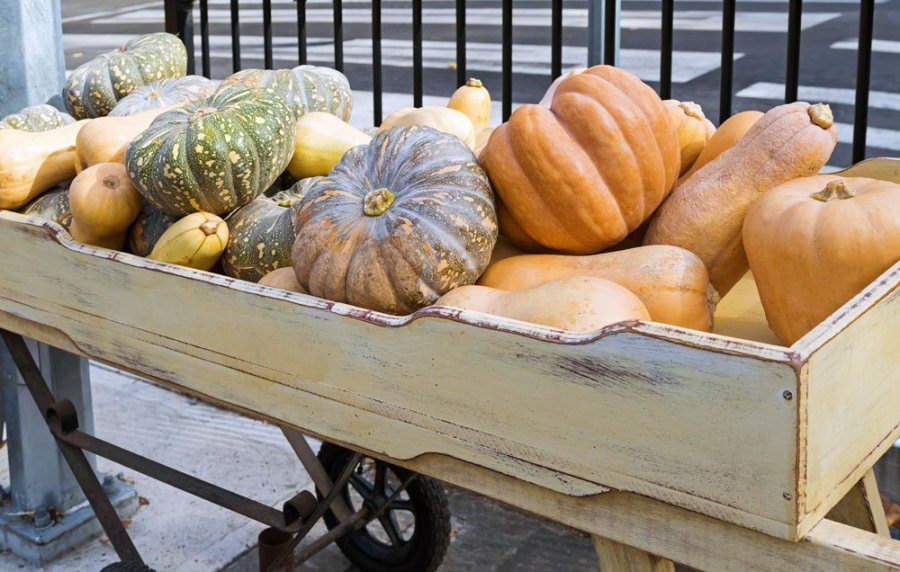
Halloween and Thanksgiving have rekindled my interest for pumpkins…or squash – since they belong to the same family.pumpkins1

Nothing says “Autumn Bounty” quite as charmingly as some bright and cheerful pumpkins and gourds. When it comes to varieties of squash the ones I’m most familiar with are the ones readily sold in most supermarkets like acorn, butternut and spaghetti.  I love making butternut squash soup and have baked with other kinds. But now that Fall is in full swing let’s have a look at some other intriguing varieties found at your local farmers’ market, roadside stand, or grocery store and check out the incredible range of options available.  They also come with an amazing list of *health benefits. But if you don’t want to eat them they make really nice table displays.  These are just a few for example:

Moonshine

pumpkinsmoonshine

Who says pumpkins have to be orange? White pumpkins show up well outdoors at night, making the mid-sized Moonshine pumpkin perfect for painting or displaying as-is. Also look for tiny white pumpkins such as Snowball or the giant white Polar Bear pumpkin, which can be as large as 65 pounds.

Fairytale

pumpkinsfairytale

Also known as the Musque de Provence, this French heirloom is straight out of Grimm’s illustrations. The squat, deeply grooved fruit run 8-15 pounds and will keep for many months at room temperature. These pumpkins have deep orange, moderately sweet flesh. Also look for Long Island Cheese, which is less deeply creased and slightly smaller, and a mini version called Autumn Crown that runs just a few pounds.

Green Goblin

pumpkinsgreengoblin

This Italian heirloom (also known as Marina di Chioggia) can grow up to 10 pounds. Its knobby green skin hides rich, sweet, yellow-orange flesh that is perfect for pies when you get tired of looking at it. A similar option is Black Futsu, an equally knobby but slightly smaller, black-green heirloom pumpkin from Japan that slowly turns gold after harvest. Black Futsu features firm flesh with a flavor reminiscent of chestnuts or hazelnuts.

Cinderella

pumpkinscinderella

I challenge you to look at this French heirloom without imagining tiny carriage wheels and a fairy godmother. This deep scarlet-orange pumpkin, which is also called Rouge Vif d’Etampes, runs 10-15 pounds and its dense, moderately sweet flesh makes great pie. Also look for a similarly shaped pure white version called Valenciano, a slate blue/dark green variety called Jarrahdale, and, if you’re really lucky, Bliss, a dark green variety with golden speckles and spots.

Hooligan

pumpkinshooligan

No room for a full-size pumpkin? Try this lovely little mini pumpkin. Also look for Casperita, a pure white mini variety; Autumn Crown, a flattened tan-colored mini pumpkin; Munchkin, a classic orange mini pumpkin variety; and Sweet Dumpling, a white mini variety with green stripes. These mini pumpkins make delightful tealight holders. Or, bake them up—they’re just as tasty as acorn squash.

Turks Turban

pumpkinturks

This classic French heirloom is often called a gourd, but it’s actually a delicious nutty-flavored pumpkin. Turks Turban, a.k.a. Turks Cap, can be stuffed and baked whole, making a great vegetarian/vegan alternative for a festive main dish with the right stuffing.

Speckled Swan Gourd

pumpkinsspeckledswam

These unique, birdlike gourds are worth seeking out. Like all gourds, Speckled Swan doesn’t contain edible flesh when ripe, but with a little care, you can cure the hard shell and keep it for many seasons. Look for Bottle or Birdhouse gourds, which have a similar shape but are white or pale green.

Snake Gourd

pumpkinssnake

Depending on how they were grown, these striking gourds can resemble caveman clubs or sinuous coiled serpents. Immature fruit up to about 2 feet long can be eaten like summer squash (if you can pierce the skin with your fingernail, it’s likely tender enough to eat). As Snake Gourds ripen, their flesh disappears, leaving behind only seeds and a hard shell. Also look for Dipper gourds, which look similar but have a rounded bulge at the tip.

Who knew?

*Health Benefits: incredibly rich in vital antioxidants and vitamins, they contain a rich source of minerals like copper, calcium, potassium and phosphorus. Pumpkin seeds indeed are an excellent source of dietary fiber and mono-unsaturated fatty acids, which are good for heart health. In addition, the seeds are concentrated sources of protein, minerals and health-benefiting vitamins.

Source: http://www.rodalesorganiclife.com/