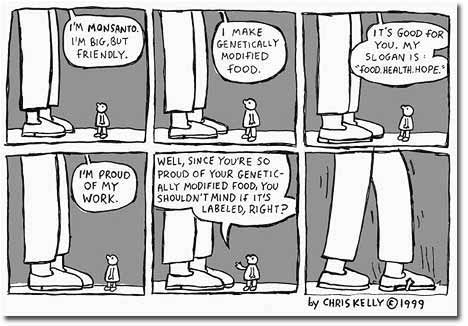
Surveys repeatedly show that 80 to 90 percent of Canadians and Americans want labelling to tell them when food has been genetically engineered. Yet huge corporations don’t want us to know what’s in our food, and governments are listening to them instead of consumers.
But in November 2012, Californians will vote on Proposition 37, which would require clear labelling of foods produced through genetic engineering. Why is this relevant to us in BC? A victory in California could be the catalyst that finally brings GE food labelling to other states and because of our history of harmonizing food laws with the US, to Canada.
The corporations who profit from GE foods are spending huge amounts of money on ad campaigns designed to scare Californians into voting NO to proposition 37. Of course Monsanto’s on that list, but so are many big grocery brands that might be on your pantry shelves. We were saddened and perplexed to see Ocean Spray among them; why would a farmer-owned co-operative fight so hard to keep consumers from knowing what’s in their food?
On a more positive note, we’re proud of Richmond based Nature’s Path, a heroic local company that has given funds to support the YES campaign. Thank you, Nature’s Path – and all the other companies and individuals who are standing up for the rights of consumers. After all, when the citizens of countries as diverse as China, UK, Russia, Saudi Arabia, South Korea, Latvia, and many others (40+ in total) already have laws requiring the labelling of GE foods, isn’t it perfectly reasonable for us to expect the same?
Don’t miss listening to “Transforming Health” with host Brad King for the most up-to-the-minute interviews with leading health professionals – Live every Wednesday @ 12PM-PST/3PM-EST on VoiceAmerica.com – #1 internet radio station in North America. Listen to it live or listen to previous episodes at: http://www.voiceamerica.com/show/1686/transforming-health
*The Vancouver Health Show takes place this weekend at the Trade and Convention Centre. Brad King will be one of the keynote speakers on Saturday, November 10th.
Willpower isn’t just some storybook concept. It’s a measurable form of mental energy that runs out as you use it, much like gas in your car. That’s why your resolve to hit the gym weakens after you’ve slogged through a soul-sapping day at work.
Roy Baumeister, a psychologist at Florida State University calls this “ego depletion”, and he proved its existence by sitting students next to a plate of fresh-baked chocolate-chip cookies. Some were allowed to snack away, others to abstain. Afterward, both groups were asked to complete difficult puzzles. The students who’d been forced to resist the cookies had so depleted their reserves of self-control that when faced with this new task, they quickly threw in the towel. The cookie eaters, on the other hand, had conserved their willpower and worked on the puzzles longer. That’s good to hear as I just ate 6 cookies.
Further studies have suggested that willpower is fueled by glucose –which helps explain why our determination crumbles when we try to lose weight. When we don’t eat, our glucose drops, and our willpower along with it. “We call it the dieter’s catch-22: In order to not eat, you need willpower, But in order to have willpower you need to eat,” says John Tierney, coauther with Baumeister of Willpower: Rediscovering the Greatest Human Strength.
We can wield what scientists know about willpower to our advantage. Since it’s a finite resource, don’t spread yourself thin. Make one resolution rather than many. One tactic is to outsource self-control. Get a gym buddy. Use Mint.com to regulate your spending, or RescueTime.com to avoid distracting websites. People with the best self-control aren’t the ones who use it all day long. They’re people who structure their lives so they conserve it. That way, you’ll be able to stockpile vast reserves for when you really need it, like hauling your lazy ass to the gym. Judy Dutton for Wired Magazine.
Don’t miss listening to “Transforming Health” with host Brad King for the most up-to-the-minute interviews with leading health experts – Live every Wednesday @ 12PM-PST/3PM-EST on VoiceAmerica.com – #1 internet radio station in North America.
Well THAT got your attention – I’m talking literally speaking of course!
How getting enough sleep in general can be beneficial to getting ahead. This article by Arianna Huffington, President and Editor-in-Chief at The Huffington Post Media Group was too interesting to shorten. Read on:
Every business hungers for a tool that might give it an advantage against its competition. Senior executives spend millions on consultants, R&D, and capital investment while workers are constantly trying to enhance their skills in order to boost their standing within the company.
But for all the talk about the “efficiency of the marketplace,” it’s surprising that so few companies and rising stars take advantage of one performance enhancement tool that’s been scientifically proven to have multiple benefits — and which also happens to be absolutely free. I’m talking about sleep.
So many of us fail to make use of such a simple and valuable tool; in fact, we deliberately do just the opposite and make a fetish of not getting enough sleep, in the mistaken — and costly — belief that success results from the amount of time we put in, instead of the kind of time we put in. I once had dinner with a man who bragged to me that he’d only gotten four hours of sleep the previous night. It was not easy to resist the temptation to tell him that he might have been a lot more interesting if he’d gotten five.
Indeed, there’s practically no element of workplace success that’s not improved by sleep and, accordingly, diminished by lack of sleep. Creativity, ingenuity, confidence, leadership,decision making— all of these can be enhanced simply by sleeping more. ”Sleep deprivation negatively impacts our mood, our ability to focus, and our ability to access higher-level cognitive functions,” say Dr. Stuart Quan and Dr. Russell Sanna, from Harvard Medical School’s Division of Sleep Medicine. “The combination of these factors is what we generally refer to as mental performance.” They also point out that lack of sleep was a “significant factor” in the Exxon Valdez wreck, the explosion of the Challenger Space Shuttle, and the nuclear accidents at Chernobyl and Three Mile Island.
Researchers at the Walter Reed Army Institute of Research likewise concluded that “insufficient sleep can adversely affect a variety of cognitive abilities, ranging from simple alertness to higher-order executive functions.” It’s hard to be a higher-order executive without such functions, nor with lowered “global emotional intelligence,” “reduced self-regard, assertiveness, sense of independence, and self-actualization,” “reduced empathy toward others and quality of interpersonal relationships,” “reduced impulse control and difficulty with delay of gratification,” and “reduced positive thinking and action orientation.” Though one thing you do get with sleep deprivation is “greater reliance on formal superstitions and magical thinking processes.” Not really a great asset in the workplace – unless you work at Hogwarts.
And, yet, 41 million Americans, almost a third of all adult workers, clock six or fewer hours of sleep per night.Even if we’re not getting the seven or eight hours a night we should be, researchers have found that even short naps can give us many of the same benefits. According to David Randall, author of “Dreamland: Adventures in the Strange Science of Sleep,” even a short nap, “primes our brains to function at a higher level, letting us come up with better ideas, find solutions to puzzles more quickly, identify patterns faster and recall information more accurately.”
But of course, getting more sleep is easier said than done — believe me, I know! This is especially true in a culture that’s wired and connected 24/7. And more and more science is proving the truth that screens and sleep are natural enemies. Researchers at Rensselaer Polytechnic Institute recently published a study that showed that the light from computer screens obstructs the body’s production of melatonin,which helps govern our internal body clock and regulates our sleep cycle. Technology allows to be so connected with the outside world that we lose connection to our inside world.
So what are the solutions? Experts have many ideas but what works for you? How much sleep do you get and/or need? And what are your secrets for making sure you turn off? Here’s wishing you a good night!
You’ll like listening to “Transforming Health” with host Brad King for the most up-to-the-minute interviews with leading health professionals – LIVE every Wednesday @ 12PM-PST/3PM-EST on VoiceAmerica.com – #1 internet radio station in North America. Here’s the link: http://www.voiceamerica.com/show/1686/transforming-health
Isn’t it nice to find out that a certain vice which is somewhat indulgent is actually good for you?…in moderation.
What Makes Resveratrol a Unique Antioxidant?
Resveratrol is unique among antioxidants because it can cross the blood-brain barrier to help protect your brain and nervous system, and studies show that its benefits are wide reaching, including:
• Protecting your cells from free radical damage
• Inhibiting the spread of cancer, especially prostate cancer
• Lowering your blood pressure
• Keeping your heart healthy and improving elasticity in your blood vessels
• Normalizing your anti-inflammatory response
• Helping to prevent Alzheimer’s disease
Because resveratrol appears to be so effective at warding off many diseases associated with aging, it is often referred to a “fountain of youth” that can extend lifespan.
Already, animal studies have shown that resveratrol helped overweight mice run farther and live about 20 percent longer. It has even been found to increase the lifespan of human cells. No wonder I was able to run the half marathon after consuming several glasses the night before!
Resveratrol also seems to produce many similar benefits as exercise, and I suspect it would be a powerful addition to exercise. Maybe I’ll fill my water bottle with vino next time I hit the gym.
New research explains resveratrol’s effect on inflammation, and also shows how it can be used to treat potentially deadly inflammatory disease, such as appendicitis, peritonitis, and systemic sepsis.
The Best Sources of Resveratrol
Resveratrol is found in grapes, which produce it as a defense against fungi. Muscadine grapes actually have the highest concentration of resveratrol in nature because of their extra thick skins and numerous seeds where it is concentrated.
Resveratrol is found in abundance in red wine, and it’s highly soluble in alcohol, meaning your body may absorb more of it from red wine than from other sources. But there ARE other sources out there, including cocoa, dark chocolate and peanuts.
If you opt to take a resveratrol supplement (I always prefer the natural solution), there are numerous products on the market. Be sure to look for one made from muscadine grapes that uses WHOLE grape skins and seeds, as this is where many of the benefits are concentrated. That’s grape news!
Don’t miss listening to “Transforming Health” with host Brad King for the most up-to-the-minute interviews with leading health experts – Live every Wednesday @ 12PM-PST/3PM-EST on VoiceAmerica.com – #1 internet radio station in North America. Here’s the link: http://www.voiceamerica.com/show/1686/transforming-health
On Tuesday I posted a recipe for salmon using saké kasu as one of the main ingredients. Not only is this dish delicious and easy to make but have a look at the amazing health benefits:
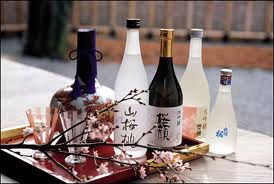
Japanese saké contains many components, including amino acids. Amino acids have many beneficial aspects for health because they activate brain function, strengthen the immune system and may help to prevent cancer.
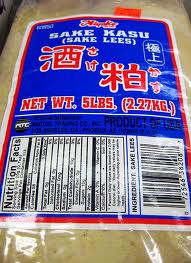
Saké -Kasu is a by-product of sake. In other words, it is what is leftover after making sake. Saké is made from rice, koji (mold), and water. After the process of alcoholic fermentation, the liquid (finished sake) is filtered and leaves mash behind. This mash is called “sake lees.” Among other benefits the “lees” are found to activate a kind of lymphocyte known to kill only cancer cells.
Saké -kasu (or sake lees which are the leftover bits) is known for other remarkable health benefits which includes helping to lowerblood cholesterol and making skin healthier. In Japan, you’ll find saké -kasu beauty treatments such as saké -kasu massage, facial masks and bath products. It is said to be used as one of the main ingredients (pitera) in *SK-II facial products – a top seller in Japan (and abroad) *Pitera is the broth that’s made by the yeast.
The history of SK-II goes back to the 1970s when a scientist in Japan noticed the very soft and youthful hands of women working in a Japanese saké brewery. After years of research the scientists were able to isolate the natural, nutrient-rich liquid which they called *Pitera.
Preventing aging and senility: It is well known that people who drink Japanese saké every day in moderation, have better brain function than people who don’t drink at all. It was also recently discovered that peptide in Japanese saké is very effective in preventing forgetfulness. That’s great news because I never forget to drink mine! Campai!……cheers!
Don’t miss listening to “Transforming Health” with host Brad King for the most up-to-the-minute interviews with leading health professionals. Live every Wednesday @ 12PM-PST/3PM-EST on VoiceAmerica.com – #1 internet radio station in North America. Here’s the link: http://www.voiceamerica.com/show/1686/transforming-health
ONE week from tomorrow I’ll be running my second half marathon – the Nike Women’s in San Francisco and I’m hyped. The natural progression to that would be to run a fullmarathon however I’m not so sure I want to. It’s not only the extra time and dedication but physically it doesn’t sound the healthiest for your joints and body. Having said that…
Thousands of healthy women run marathons every year!
But there are plenty of stories out there about elite womenrunners who have become too thin, missed periods, and had other health problems. How dangerous is it for women to run marathons? In fact, is it dangerous at all? Some people certainly seem to think so. So…
Are Women Marathoners Endangering Their Health?
“It is generally not dangerous for women to train for and run in marathons, as long as proper nutrition is maintained and precautions are taken,” says Michael Lu, MD, assistant professor of obstetrics and gynecology at the UCLA School of Medicine.
As with most major physical undertakings, however, there are some risks. Most of these are related to going to extremes: training too hard, eating too little, getting too thin. “The greatest potential gynecological risks of marathon training for women involve amenorrhea(no periods), osteoporosis, and disordered eating, in what is commonly called the female athlete triad,” Dr. Lu explains.
In their article on the female athlete triad in American Family Physician , Julie Hobart, MD, and Douglas Smucker, MD, MPH, state that the female athlete triad is a combination of three interrelated conditions that are associated with athletic training: disordered eating, amenorrhea (absence of menstruation), and osteoporosis. According to Hobart and Smucker, “Athletic endeavors such as . . . distance running…that emphasize low body weight and a lean physique can increase the risk of developing the female athlete triad.”
Eat Enough and Eat Well
A great benefit to training for a marathon is that you can eat more—in fact, you have to so you can replace all the calories you burn during training. Make sure your diet is adequate to meet your body’s increased demands. In general, the diet should provide adequate calories to meet the athlete’s energy needs. It should be balanced, providing all macronutrients and micronutrients from a wide variety of foods.
Keep Training in Check
One of the contributing factors to the female athlete triad is excessive exercise—and with marathon training, that’s obviously a possibility. The amount you can train is largely determined by genetics. The less there is of you, the easier it is to do weight-bearing exercise, but if you start to get too competitive and try to shed weight so your times will get faster, there can be health risks.
As with most things, moderation in marathon training is key. Don’t do more than your bodycan handle—and that amount is different for every runner. B Well but most of all HAVE FUN!
GOOD LUCK TO ALL THOSE RUNNING THE VICTORIA MARATHON TOMORROW!
You might also like: Is Stress Ruining Your Life?Find out how to stop stress from ruining your life! Brad King, Host of “TransformingHealth” interviews Dr. Jack Singer – The Patch Adams of Psychology. He will inspire, energize and motivate you to not only lighten up in your workplace, but to positively impact your immune system so you can add life to your years and years to your lives! If you want to significantly reduce stress from your daily life tune in for Dr. Jack’s stress busting tips… they will be life changing. Listen up at: http://www.voiceamerica.com/episode/55759/is-stress-ruining-your-life
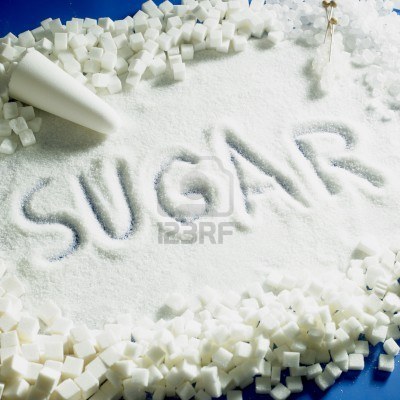
SUGAR (even the natural kind) is currently getting a bad rap from best-selling books, diet gurus and even mainstream doctors. Experts share what the real problems are and the smartest ways to cut back.
Take the following quiz below to find out if you’re hooked. Answer True or False for each question.
1) I crave something sweet after nearly every meal. 2) I have at least one soft drink (diet or regular) a day. 3) When I see something sweet, I have trouble passing it up. 4) I almost always have some sort of chocolate or candy every day. 5) I sometimes feel out of control when eating sweets.
If you answered TRUE TO THREE OR MORE questions, you’re under sugar’s spell and it might be time to start curbing your intake.
Guilty to numbers 1, 3 and 4. My correct score should really be 2 ½. I struggled with answering yes to #1 because I don’t always eat sweets after breakfast or lunch.
WHAT’S SO BAD
It can add belly bulge. Ab fat anyone? What you eat matters – counting calories are not the only thing that counts. Sugary foods are rapidly absorbed, precipitating insulin spikes that cause rebound hunger and elevated triglyceride levels (increasing your risk of heart disease). Scarier still, surplus fructose can build fat deep in the abdomen, which is the worst place in terms of health risks.
IT AGES YOU
Excess suger in your diet can trigger the formation of advanced glycation end-products, which can cause premature lines and wrinkles. WAIT: you can use sugar based products for your skin? Sugar actually works well as a topical exfoliant, gently sloughing off dead layers to reveal smoother, brighter skin. That’s great and all but will it still satisfy my craving for something sweet while it’s on my skin? I don’t think so! My question is can you eat sugar and then use wrinkle reducing products to wipe off the accumulated line damage after? – probably not!We’ll do skincare in another post then.
DON’T BE A FAKER
Satisfying your cravings with artificial substitutes isn’t a smart swap. People who drink diet sodas are more likely to gain extra pounds. One possible explanation? The faux stuff primes your palate to crave sweets, making it harder to scale back. Plus the fake stuff is even worse for you in general.
SUGAR GETS BUSTED
Since it’s publication in February, the “Blood Sugar Solution” has been generating a buzz and landing on the best-seller list for at least 12 weeks. Followers of Dr. Mark Hyman’s no-added-sugers edict are staving off what he calls “diabesity,” a cluster of symptoms that can lead to serious health issues. (Little Brown, $28; amazon.com)
Slashing Sugar Made Simple: some strategies to slowly step away from sweets without sacrificing taste or satiety.
Pick the finest fruit – few dietitians advise cutting out fruit entirely since it has fiber along with the natural sugars. Focus on low-sugar, high-fiber, and phytonutrient-rich choices like blueberries and peaches over super-sweet fruits like pineapple.
Beware of breakfast cereals – even the seemingly wholesome varieties can be laden with the white stuff. A serving of Kashi Go Lean Crunch has a whopping 13 grams of sugar. That is the main reason why I make my own granola. The only additional sugars is with added dried fruit.
Avoid Hidden Sugar – sweeteners go by many names and can be lurking where you least expect them. Common sources include breads, ketchup, pasta sauce, peanut butter, salad dressings and soups. Read the labels carefully. Bone up on the aliases you may find on labels, such as brown rice syrup, corn syrup, solids, dexrin, galactose, and malt syrup.
Sip Smarter – be wary of drinking too much juice. Juice might seem health savvy -witness the juice-cleanse craze. But most are high in sugar too. Eating the whole fruit is more filling for fewer calories or dilute your juice with some water. I love juicing but will add veggies like carrots, kale and cucumber to balance out the fruit intake. Watch out for the sugar intake in energy shakes too.
“Only Irish coffee provides in a single glass all essential food groups: alcohol, caffeine, sugar and fat.”
*TIP: It may not be chocolate but for a healthy take on something sweet try baked sweet potatoes sprinkled with cinnamon.
**If you can’t CUT OUT then at least CUT DOWN. Eating sugar in desserts, ice cream, etc. is my guilty pleasure but I vow to cut down…..bit by bit (or bite by bite).
You might also be interested in: How YOU can become almost totally resistant to colds, influenza, and other infections with the bestselling author of SUPER IMMUNITY on Transforming Health with Brad King. VoiceAmerica.com – #1 internet radio station in North America. Listen to this and other health related issues with Brad King every Wednesday live at noon (pacific standard time) and 3:00 p.m. (EST).

 Surveys repeatedly show that 80 to 90 percent of Canadians and Americans want labelling to tell them when food has been genetically engineered. Yet huge corporations don’t want us to know what’s in our food, and governments are listening to them instead of consumers.
 For further information visit: http://carighttoknow.org Taken from Edible Vancouver Magazine



 Girl Who Would be KING on Life, Style and INSPIRATION.
You must be logged in to post a comment.