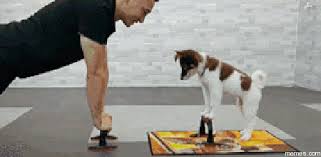
We already know they’re more dog friendly than most places in and around Palm Springs but here’s a place where you can actually work out with your pooch. It’s called Venus de Fido and it’s in Palm Desert. I mean I’m not sure my two are up for pilates or anything like that, but Layla is bugging me to get a membership to this place.
Not only that, but they have a specialty retail doggy boutique that’s dedicated to offering stylish, high-quality, unique products. After your work-out you can check out the fashion-forward designer apparel, carriers, accessories, eco-friendly grooming and spa care products, novelty toys, premium pet foods, treats to share and other fabulous dog gifts and goodies. Oh; now I see…that’s probably what Layla really wants.
Fido & You Fitness Class
The Fido & You fitness class combines light cardio, with yoga and core strengthening exercise for you while providing agility and trick training for your dog. You can check out Fitness Class/Workshop Calendar for dates and times.
These classes are reason enough to move to Palm Desert:
Make Over Monday – All Day Spa Special and Happy Hour (4-6p)
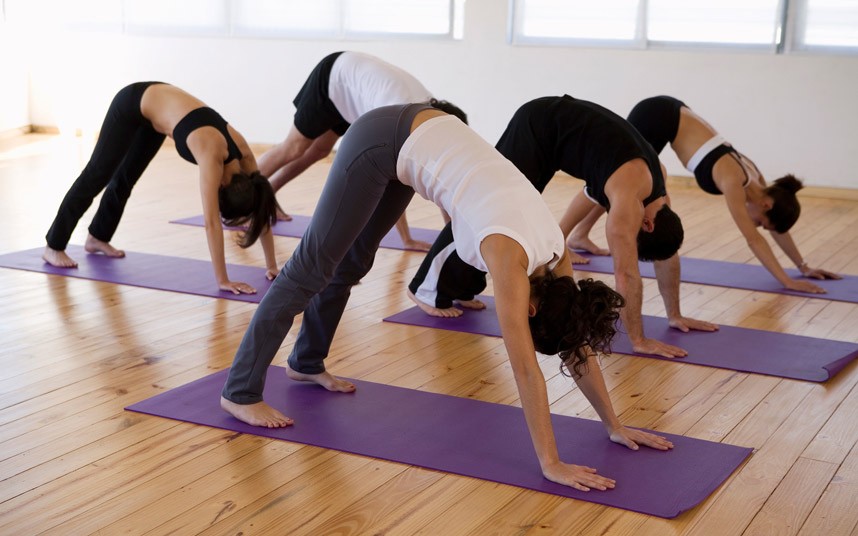
I’ve belonged to the same gym which is located a very short walking distance from where I live for more years than I want to admit. If I really stop to think about it, If I went every single day since day one, my body would be in perfect shape right now. But because I only go a few times a week instead, it is in almost perfect fairly good shape right now with room for improvement..always. My criteria is location, equipment, cleanliness and classes. The classes are excellent and I go to the varied yoga classes with different instructors and practices. I must admit that as much as I want to love working out with weights I don’t. I tried and tried and liked seeing the results because weights really do work but I didn’t enjoy it. I have some weights at home that are still sitting on the floor waiting to be picked up…someday. I don’t even enjoy spinning because I’d much rather ride a bike outside and I don’t like to sweat very much. So spinning is out. Running, Yoga and Dancing (tango/swing) works for me right now. And I always walk. I can walk and walk and walk for miles as long as my footwear is comfortable. Basically I feel better about myself when I’m doing a physical activity to improve my body, but sometimes…
No matter how dedicated you are to fitness, sooner or later, it’s going to happen: You’re going to skip a workout… and another… and another. Maybe you can blame a vacation, a mile-high pile of paperwork at the office or just your run-of-the-mill funk. Whatever the reason, before you know it, you’re out of shape.
A running buddy helps you to get motivated
Neglecting the gym every once in a while is nothing to worry about—after all, sometimes your body needs to rest and recover. But, when you hit pause on your workouts for more than a week, you might actually be throwing your fitness level into rewind. Here is an article I read on thedailybeast.com
How Fast Will You Fall Out of Shape?
You worked hard to get fit, whether by logging regular runs, or striving for new personal bests in your bench press. When your workouts fall by the wayside, how fast you fall out of shape depends on more than just how much time you spent away from the gym. Your overall fitness and the type of workout you’re missing will also impact your losses, says James Ting, M.D., a board-certified sports medicine physician with the Hoag Orthopedic Institute in Irvine, CA.
As a general rule, the fitter you are, the longer it will take your muscles turn to flub, he says. Your physique doesn’t like change; it’s constantly trying to achieve homeostasis. So the longer you have been exercising (and the fitter you are), the more time it will take for your body to say, “Well, I guess we don’t need to build muscle anymore.”
If it’s only been a week since you broke a sweat, don’t stress. Whatever your workout history, it’ll take more than seven days for your body to soften. But two weeks? You might not get away with that as easily. One Journal of Applied Physiology study suggests that easing up on your workouts for just 14 days can significantly reduce your cardiovascular fitness, lean muscle mass, and insulin sensitivity. Meanwhile, it can take two months or longer to see complete losses of your fitness gains, according to Ting.
Endurance vs. Strength: Which Will You Lose?
Your body will react differently depending on whether you’re skipping endurance exercise versus strength training, says exercise physiologist and trainer Marta Montenegro, M.S., C.S.C.S.
That’s because your muscles contain both type I (slow-twitch) and type II (fast-twitch) muscle fibers. Type I fibers contribute to endurance performance. Type II fibers are more powerful, and their “fast-twitch” capabilities help you power through high-intensity exercise or strength training.
During your day-to-day activities (like walking, talking, sitting at a desk, etc.), your type I fibers are contributing to the bulk of your efforts. But you really have to work to get your type II fibers to switch into gear. So, when you take a break from exercise, your type I fibers are likely still being used, helping to prevent them from breaking down. But some of your type II, fast-twitch fibers may be rarely, if ever used, if you aren’t working out, she says.
That may explain why type II fibers tend to atrophy more quickly than type I fibers, she says. In other words, your max bench press will suffer before your 10K time does when you’re slacking. If you’re taking a break from strength work or high-intensity intervals, you’ll notice a huge difference when you finally do go back to the gym.
Endurance athletes aren’t entirely out of the woods, though. When you perform regular cardio, your type II muscle fibers gradually change from type IIx to type IIa, Montenegro explains. Type IIa fibers are key to endurance performance: They are powerful, but don’t tucker out as quickly as IIx ones, meaning they can help power your long runs. When you take a break from your long runs and rides, this essentially reverses, and your percentage of type IIa fibers decreases, while your IIx fibers increases, she says. So prepare to tire out way faster.
Breaks Aren’t All Bad
Before we terrify you into heading to the gym right now, know that it’s actually good for you to skip workouts from time to time. In fact, if you train hard , taking a break can actually help improve your strength, muscle development and aerobic fitness, says certified strength and conditioning specialist Brad Schoenfeld, Ph.D., assistant editor-in-chief of the Strength and Conditioning Journal.
Days off can also improve your mental fitness. “Your body and mind both need time to recover for overall health and in order to achieve optimal performance,” says Ting. “Failing to recognize this and training too hard can lead to fatigue and, ironically, underperformance, the so-called overtraining syndrome.”
If you’re sore more than 72 hours after a workout, you’re feeling ill, or your fitness progress is stalling, it may be time to back off. How long should your break last? “There’s no hard and fast rule for how long a ‘break’ from exercise should be,” Ting says. “It may be as short as a few days, but it’s important to realize as well that it can also be up to one to two weeks without any significant detriment or loss in previous fitness gains.
Just remember that taking a break from exercise doesn’t (and shouldn’t) equate to gluing your butt to the couch and Netflix-binging. “Taking up some light activity that isn’t part of your typical training regimen, such as yoga or even a long walk or leisurely bike ride, can all constitute a ‘break,’” Ting says. (Oh, I see…I’ve been taking breaks all this time instead of actually working out).
How to Jump Back Into Your Workouts
Depending on how long you took off—and lazy you were—you might not want to jump back into your workouts, but rather ease into them. If you’ve taken any more than a couple weeks off, you’ll probably notice some differences. After a month or more, you’ll definitely want to get started with a less-intense version of your regular workout, Ting says.
“The most important thing is to back off a little for the first week,” Schoenfeld says. “Choose a weight where you will be able to stop several reps short of failure on your sets. The following week you should be able to train at your previous level, assuming the reason for stopping wasn’t an illness or injury.” Meanwhile, if you’re getting back into running, start at a pace at which you can run comfortably and are able to speak in short sentences. After a week, try turning up the speed.
It can be frustrating to exercise at anything less than your max effort, sure, but gradual is the way to go to prevent injury. The last thing you want is to walk into the gym after a month off, try to squat your “usual” load, and throw out your back. (Hello, another month off.)
Luckily, when it comes to getting back into your pre-break shape, you do have muscle memory working for you, Schoenfeld says. There are two aspects to muscle memory. One involves your ability to carry out movements in a coordinated fashion. Wonder why your first rep on the bench press looked so sloppy? It’s because your body was learning which muscle fibers it needed to recruit, and which ones it didn’t, to properly perform the exercise.
Then second component of muscle memory involves your cells. “Muscles have satellite cells—basically muscle stem cells—that help to drive protein synthesis. Resistance training increases satellite cells and these changes remain for years,” he explains. “So even if muscle is lost from taking time away for many years, a person can regain the lost muscle much more quickly after an extended layoff.” Score.
Exactly how long it takes will vary from person to person, but by and large, you can expect to be back in fighting shape in a few weeks.
What kind of exercise do you do on a regular basis?
Source: K. Aleisha Fetters, Life by Daily Burn (thedailybeast.com)
You will find that both your mood and your energy improve when you work out.
This advice feels as repetitive as the fifteenth bicep curl, but the fact remains: Exercise is, hands down, the best anti-ager.
Everyone has a different strength capacity & choice of what works for them. Ideally the best strategy for me is a combo of running, yoga & weight training. When done properly (which is not always the case) it’s a winning combination. A lot of times I don’t really get around to using actual weights as I should so sometimes I’ll run with little wrist weights and hope that the running and some yoga moves are enough weight bearing exercise. Do what you can – no excuses. Also try not to beat yourself up when you can’t bust a move like the yoga instructor – pigeon anyone? It’s best not to stress. Read on…
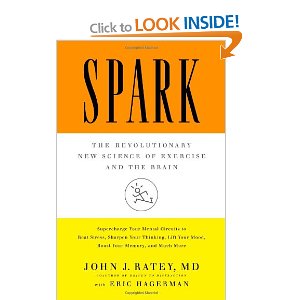
John Ratey, an associate clinical professor of psychiatry at Harvard Medical School and the author of Spark: The Revolutionary New Science of Exercise and the Brain (Little, Brown), explains how a little sweat can rewire your brain.
A fascinating and entertaining journey through the mind-body connection, presenting startling research to prove that exercise is truly our best defense against everything from depression to ADD to addiction to aggression to menopause to Alzheimer’s. Some questions:
How does aerobic exercise help the brain: “It improves your brain’s ability to form new neural connections. It promotes blood flow to the brain, creating a rich environment for brain cells to grow and withstand stress. It also appears to trigger the growth of new brain cells.”
Which exercise is best: “Look for activities that get your heart rate up to the point where you’re sweating but also provide coordination challenges. Activities like tennis, Zumba, kickboxing, or spinning all force you to plan your next move, which makes your brain work harder than if you were just doing a rote movement.”
How can I tell if it’s working? “You should notice an improvement in your overall feeling of well being. If you don’t, then you’re probably doing too much – more than 90 minutes a day – or too little. When people start an exercise program, they often overdo it, which not only increases risk of injury and burnout but also can impact brain function. Once you work out, you should find that your mood and energy improve for the rest of the day.”
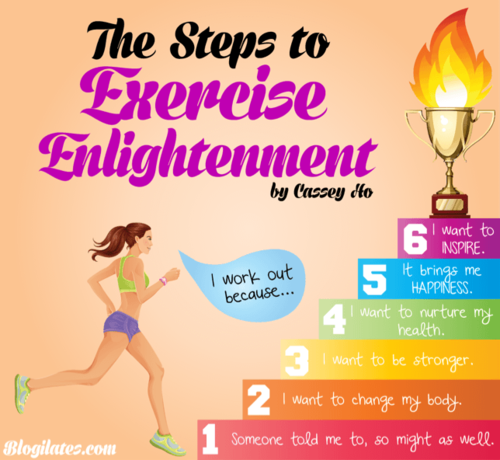
Fill in the blank – I work out because……………………….
“I work out because I feel stronger and healthier and it makes me look better”
Also, **Don’t miss listening to “Transforming Health” with host Brad King for the most evocative and informative up-to-the-minute interviews with leading health professionals – Live every Wednesday @ 12PM-PST/3PM-EST on VoiceAmerica.com – #1 internet radio station in North America.
An Interview with David Kirsch, fitness expert and author of “The Ultimate New YorkDiet” (McGraw-Hill). David owns the Madison Square Club, a private training gym in New York City, and has worked with Heidi Klum and Liv Tyler. This is an excerpt from his interview with Courtney Balestier.
Kirsch equates exercise with brushing his teeth or talking a shower. It gets the day going. If you have that attitude, it’s easy to take fitness on the road.
Get motivated bright and early: Here’s a universal truth – if you’re not working out in the morning, you probably won’t do it later in the day either. You’re going to be tired from meetings, buzzed from the wine at lunch, later for your dinner reservation, and so on. Whether you’re on a vacation or business trip, get 30 to 45 minutes of cardio out of the way first thing, and it’ll energize your day.
Use your hotel: Predictability is a good thing at the hotel gym. Don’t fool with machines you’re not familiar with – stick with the treadmill or elliptical. If you’re in a country that’s on a metric system, be less concerned with speed and more dialed into pushing yourself.
Improvise: But you don’t need a gym – or a vacation’s worth of free time. My Hotel workout includes Spider-Man push-ups (feet on the bed and hands on the floor) and hand-offs with a pillow (lie on your back with arms stretched overhead and legs in the air, hold a pillow between your shins, then pass it from legs to hands and back). You can do lunges and step-ups using a chair or ottoman. Do three sets of 10 reps each for the push-ups, 10 to 15 reps for the pillow hand-offs, and 10 to 15 reps per leg for the lunges and step-ups.
Be adventurous: Travel is the perfect excuse to change your routine. If you usually run three miles, bring a great pair of cross-trainers (I like Brooks) and power walk for an hour around a new city. If you’re a fitness-class-person, ask the concierge about great classes nearby. This is often entertaining too – a body-sculpting class conducted in French can be pretty funny.
Also – **Don’t miss listening to “Transforming Health” with host Brad King for the most evocative and informative up-to-the-minute interviews with leading health professionals – Live every Wednesday @ 12PM-PST/3PM-EST on VoiceAmerica.com – #1 internet radio station in North America.
“Physical fitness is not only one of the most important keys to a healthy body, it is the basis of dynamic and creative intellectual activity.” ~John F. Kennedy
“Just because you’re not sick doesn’t mean you’re healthy” ~Author Unknown
“Life expectancy would grow by leaps and bounds if green vegetables smelled as good as bacon.” ~Doug Larson
“If you can’t pronounce it, don’t eat it” ~Common sense
“In order to change we must be sick and tired of being sick and tired.” ~Author Unknown
“Health is like money, we never have a true idea of its value until we lose it.” ~Josh Billings
“Time And health are two precious assets that we don’t recognize and appreciate until they have been depleted.” ~Denis Waitley







 “Just because you’re not sick doesn’t mean you’re healthy” ~Author Unknown
 Girl Who Would be KING on Life, Style and INSPIRATION.
You must be logged in to post a comment.