Learning from our ancestors

Balance.  Moderation.  Variety.
It seems to be the key ingredients to living well and that includes eating well. Whether you were recently celebrating Passover or Easter you more than likely enjoyed good food amongst friends and probably overate a little…or a lot.  Without really meaning to.

Never mind the Passover Brisket.  I will pass over that one. On Easter Sunday we had dinner at a friends house.  Spiral ham with pineapple, homemade scalloped potatoes, caesar salad, etc.  Of course dessert afterwards and then we all went home with a selection of curated individual goody bags from Purdy’s filled with chocolate easter eggs, bunnies, English toffee, etc.  But it’s a special treat and thank goodness it’s only once a year. It should really be guilt free but we always complain later that we should not have gone for that second third helping.  Why do we have friends that make it so darn difficult?  Why are they such good cooks?

Anyway I’m way off topic because where I was meaning to go with this post was to talk about ancient foods being the key to preventative medicine.  Our grandparents used to talk about the many ways people of their time used to heal themselves for common health issues and illnesses.  It’s just something to discuss and consider.

The use of traditional remedies, usually homemade preparations and herbal infusions was common practice. The lack of readily available medicines and healing remedies now known to us existed but were not as widely accessible as today. This forced our ancestors to focus more on prevention as a priority.  It’s a good start.

Hippocrates’ famous quote “Let food be your medicine and medicine be your food”, dating back to 400 B.C., reflects this ideal of focusing on prevention.  The concept of using food for prevention is even found as far back as 2000 B.C., with the Egyptians using honey, garlic, radishes and turnips as well as figs, nuts, salts and spices in their daily diets to fortify the body.

Honey, for example, is one of the oldest recorded foods, used for preventative purposes.  Its unique chemical composition, low humidity and high acidic levels create a low pH environment (3.9 on average), an unfavourable atmosphere for bacteria and other micro-organisms to grow.  Raw honey is a true natural antibiotic. I put a teaspoon of raw, organic unfiltered honey in my lemon water almost every morning to help protect my immune system.  I now add turmeric, cayenne + fresh ginger to the mix.  You can never be too sure.

Vinegars, salts and spices have also been important cornerstones in the diets of our ancestors.   Vitamin C, although it was not discovered until the 1900’s, played a critical role in the everyday diets of the past. Water soluble vitamins found in fruits and vegetables were not yet understood however they were known to consume large quantities of fruits like oranges and lemons high in vitamin C.

In the Amazon of Peru, natives have historically consumed Camu Camu, a superfood that we know today is packed with the highest concentration of natural Vitamin C in the world.

Eating well means to ingest diverse food each day to get the nutrients your body needs to support and maintain good health.  It’s all about balance, moderation and variety.  Even without technology, our ancestors understood this and there’s still much to learn from them.

We can only do our best.

Source: Jorge Urena (founder, president & CEO of UHTCO Corp. – a Canadian company dedicated to create, manufacture and distribute the most unique high quality products from Peru).


Style: Standout Handbag for Spring

Striking + Sustainable.  A Spring Carryall with a Purpose

Photo: Robby Mueller
Carry It Everywhere

Sunny days are bound to be coming our way sometime soon I hope.  When they do I’ll be carrying my handmade handbag which was the hero item in the Spring Box of Style sent to me from the people over at the Zoe (Rachel Zoe) Report.

I wanted to share it with you because not only do I think it’s attractively versatile and convenient to carry around, the black and white carryall by *Tribe Alive is made with love by female artisans in India. “Without meaningful employment these women could have fallen into the sex trade epidemic which runs rampant in the communities we work,” shares Tribe Alive founder Carly Burson. This bag provided invaluable skills training and fair wages to its creators, making it even more special to carry for festival season or on the daily.

courtesy Tribe Alive

*Tribe Alive is a fair-trade accessory label that supports independent artisans in developing countries.  The striking carryall is made of foot-loomed fabric and cognac brown leather and produced on a small-batch scale to ensure the highest quality.

The beautiful handbag provided five months of employment for more than 150 Indian artisan partners in three cities. From the weavers in Panipat to master tailors and leather workers in Delhi to the logistics team in Jaipur, this bag positively impacted every link of the supply chain.

courtesy Tribe Alive

That’s truly a wow factor.


Feel-good Friday: Road Trip

Have Van, Will

This had to be one of the more pleasurable road trips I can remember ever having taken from Palm Springs to Vancouver.   

Normally once the decision is made to drive back, we’re anxious to get going and get home as quickly as possible.  Even though you can make the trip in two days we never have.  The norm is a three night hotel stay.  But this time we took a few extra days to take it easy (vacation from vacation?) and explore uncharted territory (read wineries & hotels).

The Dancing Fox in Lodi
Delicato Winery in Lodi with Cher & Jack.  He didn’t like the wine.  And here we look like lumberjacks.

After the first night in Fresno we drove to the cute little town of Lodi for wine tasting and lunch with friends who were also making the trek back to Vancouver in their own truck with their own dog. We stayed close and on their excellent recommendation we stayed at the Gaia Hotel & Spa just outside Redding Ca. by the Sacramento River.  It was very relaxing with great service, a good restaurant and waterfalls. 

The next day we went to the picture perfect artistic little city of Ashland, Oregon for lunch.

Lunch at Louie’s sitting outside by the Ashland Creek.

After spending the evening at a hotel in Salem, Oregon we decided to part ways with our friends because we wanted to check out a rescue dog in the area – a 7 yr. old female sheltie.  Though we never ended up meeting the dog as the lady who had her decided to keep her. I thought it would be a nice idea to get a female to mix with the males but since it never happened – maybe it’s better for both parties.  In the end I only want what’s best for the dog.

So we ended up having lunch at the Willamette Valley Vineyard instead which was amazing. Our charming server Robert looked after us very well.

Willamette Valley  on an overcast day
I had a few good flights to make the road trip easier (happier?)

Lastly, when we were only a few hours away from our destination we decided to spend two nights in a downtown hotel in Seattle and visit with old friends who used to live next door to us in Toronto.  There we used to have dinner parties, always kept in touch and luckily they moved closer to us, to Seattle, Wa. Yay! We have stayed in a guest bedroom before but they have two cats and we have two dogs.

With Miranda who cooked us a delicious dinner while her husband Dave went to get a 2003 Tuscan red from his wine cellar
King Arthur or Merlyn (I can never tell which is which)

They love their hotel sleeps
Why even bother making the bed??

You know the road trip back will ultimately lead you home, but you never know where the road in between will take you.  Writer Henry Miller once said “one’s destination is never a place, but a new way of seeing things.”


Somewhere under the Rainbow, way below…there are cows.

And it’s always an adventure to see new things as well as check in with old friends and find out that everything and nothing has changed since you last saw them.

Le Panier at Pike Place Market is a must for pastries, or bread, or sandwiches, or…pretty much anything

Sweet!

Photos: d. king

Style: Fair Trade Fashion

I always look forward to Spring Break!

accessorize, accessorize….so why not an accessory for an accessory?

But to me Spring Break means a good excuse to let loose with the wardrobe. Exchange bulkiness for something reflecting the warmer (hopefully) temperature.  More color and lightness. Accessories are playful and important. Speaking of, there’s no accessory more versatile than a lightweight scarf. Especially one that is sustainable, versatile and lightweight.

This is a first of a series on sustainable fashion beginning with:

The Symbology Scarf received in my Rachel Zoe Spring Box of Style is both pretty and purposeful.  This exclusive collaboration is also feel-good Fair Trade Fashion.

The bright, screen-printed iteration of sustainable fashion label Symbology is so much more than a pretty add-on. Boasting a chic peacock-feather print and a gold-berry colorway that pays homage to Indian bridal saris, the creation of this warm-weather staple also empowered women artisans from start to finish.

Founder Marissa Heyl was inspired to start Symbology while on a research trip to India to assess how fair trade empowers craftswomen. She met artisans in remote villages and sprawling slums.  She was inspired by their resilience and incredible talent in a myriad of art forms. Watching Gita, a young mother of three, block-print a beautiful tablecloth, Marissa envisioned it as a dress. It was her aha moment—combining her lifelong passion for fashion design with women’s rights.

Indian Inspiration

The Zoe Report x Symbology scarf was handcrafted by ten women in the desert region of the Indian Village of Sanganer, where bright sun and dry heat create the ideal conditions for printing. In this region virtually all printing is ordinarily done by men but these women were trained specifically to create this scarf for those who ordered the Spring 2017 box of style. The peacock feather design symbolizes integrity and beauty, while the deep berry and gold hues emulate Indian bridal saris.

Armed with their new skill set, these women have far greater access to design opportunities and sustained income in the future.  Which makes me feel even better wearing it.  Thank you!

Source: Zoe Report


Food:  plated pretty   

It’s a feast for the eyesmaybe more so than the palate.  Not something to be wolfed down. But she’s a pretty good looking egg when she gets properly plated.

Free-range eggs on an Isabelle Poupinel plate at the Hotel Thoumieux.                           Credit: Alban Couturier

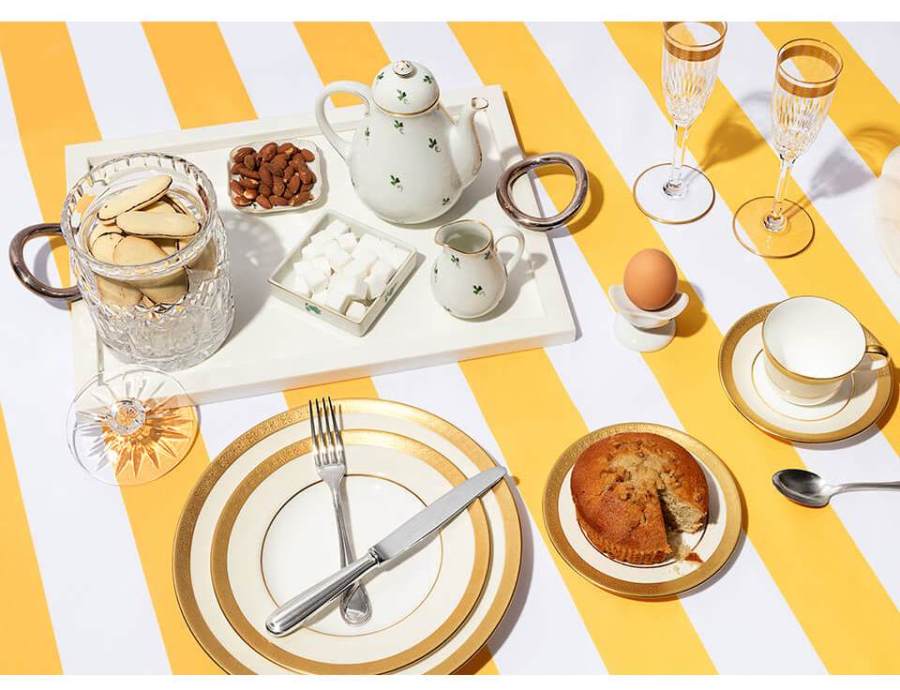
Sometimes a so-so dish can get an upgrade by an artful placement on a pretty plate.  You get to first admire what you are about to digest and by doing so and taking a bit more time, everything seemingly tastes better too.  At least in my opinion.  If you don’t believe me check this out:

The Chef & The Potter

At his eponymous restaurant inside Hotel Thoumieux near the Eiffel Tower, chef Sylvestre Wahid has earned two Michelin stars for his artful food — served on equally imaginative dishes. “The plate is like a canvas on which the dish and its colors are realized,” he says. The 300 handmade pieces in his collection were designed in collaboration with French potter Isabelle Poupinel. “I love the handcrafted aspect of her creations; the dimensions, the natural, mineral aspects to them,” Wahid says. “This parallelism between the content and the containers is really an interesting way to create harmony.” Poupinel, who has created ceramics by hand, on a wheel, for nine years, agrees — but claims that collaborating with chefs isn’t always so easy. “At first, he wanted the raw plates without enamel. I said, ‘no way!’ With sauce, or whatever, they’d get ruined. Sometimes, you have to control what chefs want in order to protect the work. They can be crazy!” she says with a laugh.

Georgia O’Keeffe: Living Modern

Speaking of Inspiring Women…

O’Keeffe in a 1929 gelatin silver print by her husband. Credit ALFRED STIEGLITZ; National Gallery of Art, Washington, D.C., Alfred Stieglitz Collection

You’ve got to admire how O’Keeffe was the master of her own public persona at a time when there was no social media.  She told photographers how to “shoot her”, not the other way around.

A refreshing new exhibition at the Brooklyn Museum (on until July 23, 2017) for the first time combines O’Keeffe’s art and her wardrobe with photographic portraits. “Georgia O’Keeffe: Living Modern

The painter of simplified images of enlarged flowers, Lake George tree trunks and New Mexico’s terra-cotta hills applied her meticulous sense of austerity and detail to every garment she owned. Some she designed and sewed herself, others she had custom made, and still others she bought off the rack or in antique shops (Japanese kimonos, for example).

O’Keeffe’s self-created image shaped her work’s accessibility, while at the same time shielding her privacy. This unity is revealed in the links drawn among some 50 works of art and 50 garments or ensembles, accessories included, and nearly 100 photographs of the artist taken by 23 photographers, from Ansel Adams and Cecil Beaton to Andy Warhol and Bruce Weber.

The greatest number of these images were taken by O’Keeffe’s husband, the eminent photographer and gallerist Alfred Stieglitz, often considered her domineering mentor, whom she met in 1916, began living with in 1918 and married in 1924.

For years, O’Keeffe limited her wardrobe to mainly black and/or white, until the Southwest loosened her color sense a bit and also introduced her to denim and jeans. She favored an androgynous look, frequenting the same New York men’s tailor — Knize — (as did Marlene Dietrich), liked Ferragamo flats and wore little jewelry. A rare favorite, visible in many photographs, was a brass brooch made for her by Alexander Calder. It represents her initials, OK, with ancient rock-painting complexity, and she wore it vertically to make it more abstract. In later years, she had it copied in silver, because she thought brass didn’t look good with her white hair.

Source: NY Times

https://www.brooklynmuseum.org/

Feel-good Friday: bien sur!

Another French Lesson courtesy ofparis3

I don’t know any better way to practice my French other than taking little tips from My Little Paris, a crazy fun blog  and way more French than mine will ever be.  It brings a smile to mon visage every time they post. And girls; OUI just want to have fun.  Oops; better brush up on my waist, I’m behind  (or above depending how you look at it) a few inches.

Fyi: fun is fun in French too.

Polished Beauty

Beauty with a Purpose – from Cult Favorite Skincare Label Tatcha

It’s something that was sent to me in the new Box of Style – second go around for Spring. I don’t have to go out looking for new product, it now comes to me and keeps on getting better. I’m happy that it’s an exfoliant with a history and a mission to empower women, as well as make them look well, more polished shall we say?

What it is: a non-abrasive, water-activated enzyme exfoliant with rice bran and licorice, so even those with dry skin can use it. Which helps to encourage cell turnover, lighten the appearance of dark spots, prevent breakouts or clogged pores, and prepare the skin for any treatments to follow.

Founder Victoria Tsai’s Mission Statement

“When I thought of geisha, I had always pictured them with their iconic white makeup. When I met them in person, I realized that underneath that makeup is baby-soft, smooth, luminous skin. Caring for their skin is part of their artistry, passed down and honed through generations. Their rituals and ingredients are timeless and beautiful—they view skin as a brilliant organ, able to care for itself with a little bit of gentle cleansing and nourishment. I fell in love with this approach and wanted to pay homage in creating Tatcha.”

Western Vs. Eastern

“Western skincare is a lot like Western medicine, using drugs to treat an issue after the fact. Eastern skincare is like Eastern medicine, focused on prevention and keeping the body in balance to avoid disease before it starts. Classical Japanese beauty rituals were born from the geisha’s rituals, which are natural, elegant and spare. Even with elaborate performance makeup, her ritual is no more than four steps: melt away her makeup, polish, plump and nourish skin. The ingredients follow the same philosophy, with streamlined formulas of active ingredients, minimally manipulated to their most efficacious form. Whether it’s oil from a camellia flower, steamed wild rose or brewed green tea, each ingredient serves a purpose.”

Why Choose Tatcha

“We develop every formula and our key active ingredients from scratch in-house with some of the most famous skincare scientists in the world, like a couture dress. The ingredients are pure and clean because of our classical Japanese heritage and because I was pregnant when we were beginning our R&D and needed a collection that is body-, animal- and earth-friendly. Finally, we believe that beauty begins in the heart and the mind. We have a 1:1 partnership with Room to Read: Every full-size skincare purchase funds a day of school for a girl in a developing country. Thanks to amazing clients and friends like Rachel Zoe, we have funded over 1 million days of school and counting.”

Have you tried it?  What exfoliant are you using and/or recommend?

photos/story: Zoe Report


Style: Italian Resort Wear you can wear

A RESORT WEAR COLLECTION

Pack light. Travel light. Be light.

In my quest to bring more lightness to all areas in my life including my clothes, I came across this Italian resort wear collection at of all places, not Italy but at an outdoor market in Palm Springs.  I fell in love with the timeless, low maintenance pieces worn with ease by renowned fashion designer Sabina Bach.

Sabina designs a comfortable, stylish and unrestricted collection, produced in Italy out of all natural fibers like the finest linen and silks.

Most of the sizes are one size fits…..most.

Showroom:

45395
San Luis Rey Ave
Palm Desert, CA 92260

I will be back!

Websitehttps://sabinabach.comI

Photos: (except first two taken from website) d. king